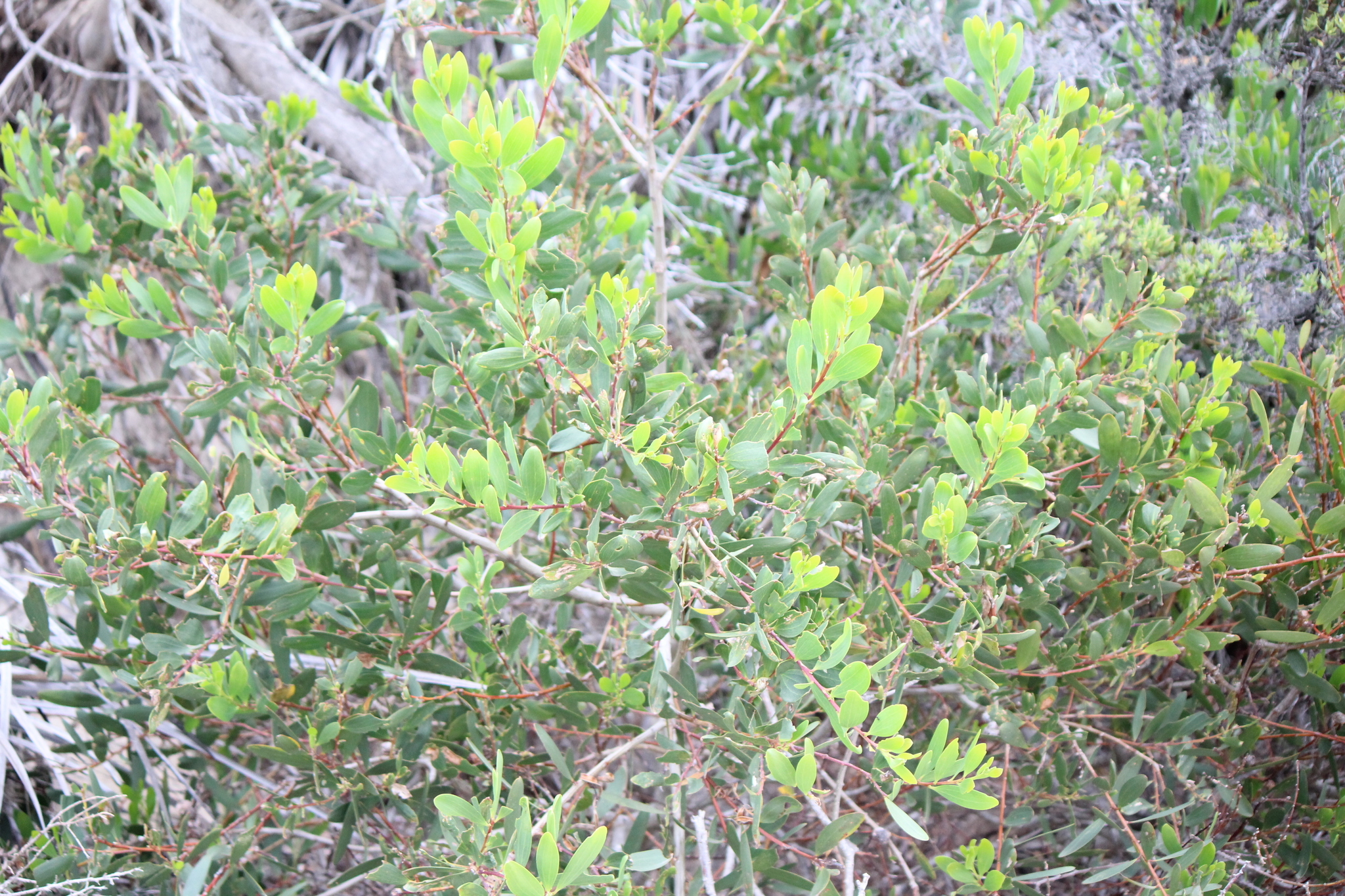
A common coastal tree or shrub like most members of the genus, the mature plant does not have true leaves but has leaf-like flattened stems called phyllodes. In A. sophorae the phyllodes are oval shaped between 5 and 10 cm long with prominent longitudal veins. The bright yellow flowers occur in the axils of the phyllodes as elongated spikes up to 50 mm long. Flowering is mainly in late winter and spring. Seed pods produced in early summer; strongly curved

At a glance

Coastal Wattle at a glance

Habitat Coastal
Size 5 m high and 15 m or more wide
Origin Native
Distribution Ranges from SE Qld through eastern N.S.W. to the southern Eyre Penin. in S.A. and toTasmania
Descriptions
Distribution
Ranges from SE Qld through eastern N.S.W. to the southern Eyre Penin. in S.A. and toTasmania
Habitat
Coastal
Size
5 m high and 15 m or more wide

Identification

Shrub to 5 m high (often low shrub, c. 0.5–3 m high, on exposed coastal foredunes), to 15 m or more wide, spreading, tangled, rarely erect. Phyllodes elliptic to narrowly elliptical (sometimes obovate to oblanceolate), 5–12 cm long, 10–30 mm wide, rounded obtuse or sometimes with a small mucronate point, subcoriaceous, sometimes fleshy, often yellowish green. Pods commonly coiled or contorted, sometimes drawn out into long beak, often firmly coriaceous.
Common Name Coastal Wattle
Aliases Boobyalla, Coast Wattle, Wadanguli (Cadigal),
Origin Native
Share
Distribution and map

Distribution provided by The Atlas of Living Australia

Classification

Classification

KingdomPlantae
SubclassMagnoliidae
SuperorderRosanae
OrderFabales
FamilyFabaceae
GenusAcacia
Synonyms

Synonyms

Acacia longifolia var. sophorae (Labill.) Benth.
Acacia sophorae (Labill.) R.Br.
Racosperma sophorae (Labill.) Mart.
References and dates
Original No original text available
Bibliography View page references
Added Wed 3 Jun 2020 @ 00:00 AM
Updated Tue 22 Sep 2026 @ 09:28 AM
Files
Type Details Version Size Added Updated Links
There are no downloads or Files for this species at the moment

Disclaimer: A lot of work goes into trying to identify and ensure accurate identifications are made, and that the listed Descriptions, Sizes, Habitats and Distribution information is as accurate and valid as possible. Unfortunately, information in this arena is ever changing and as such no guarantee can be offered that it is correct or currently valid — the information is provided as a guide, and it is always suggested that you do a little research to ensure you have the latest and most accurate information. View the references or bibliography. Feedback and comments on the information provided are always welcome.