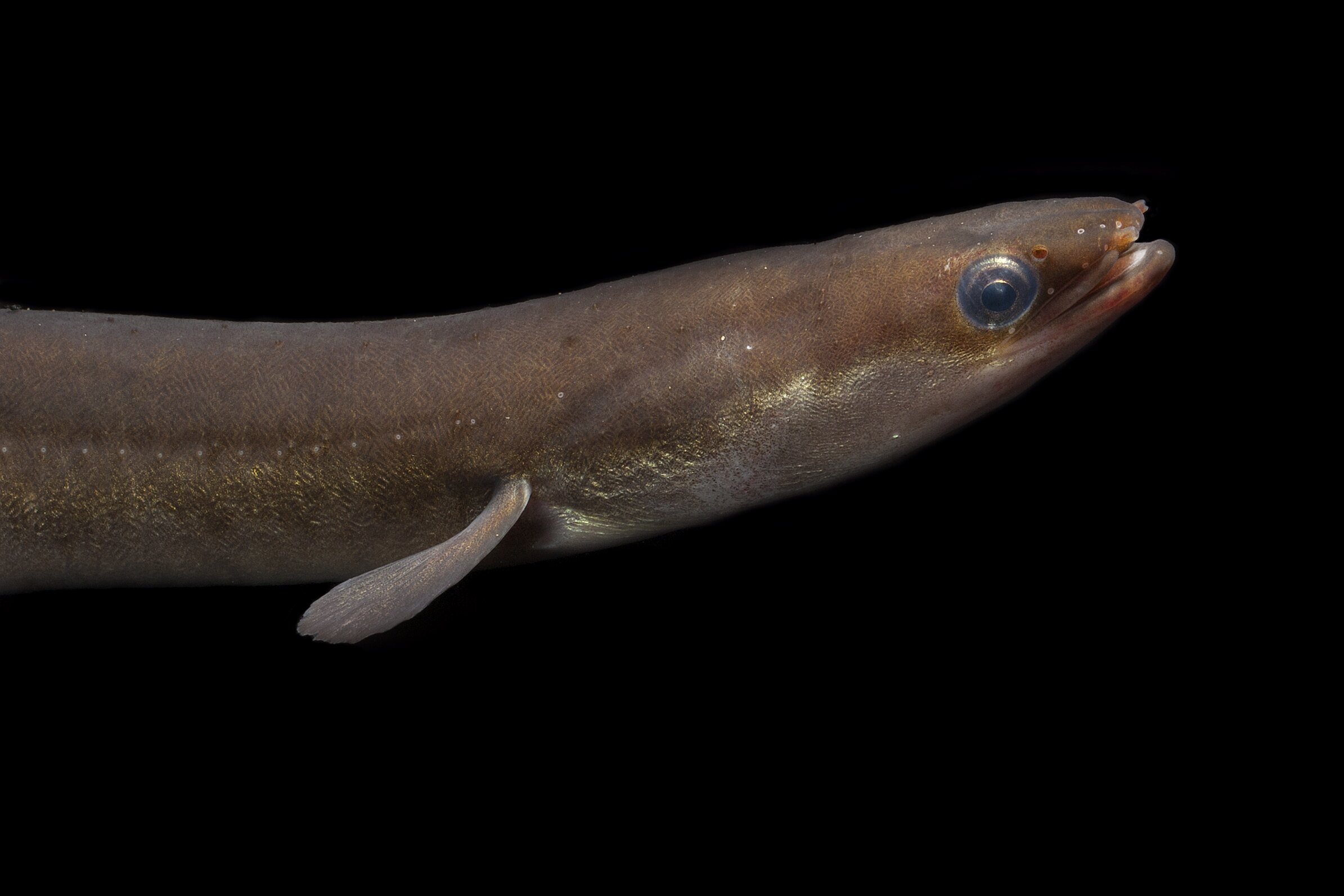
Long, tubular body with dorsal, tail and anal fins forming one fin. Small gill opening on each side of the head. Large mouth extending to below the small eye. vertical gill openings. Dorsal fin begins just forward of the anal fin. Back and sides may be olive-green or vary from pale green to olive-brown, sometimes with coppery tints above and silvery sides. Belly is greyish to silvery-white. Fin colour is dark like the back

At a glance

Short-finned eel at a glance

Habitat Slow-flowing areas in streams, lowland rivers, lakes and swamps
Size Can grow to around 1m and over 6kg.
Origin Native
Distribution Southwest Pacific, In Australia it can be found from SA to QLD including Tasmania where it is a wide spread species
Descriptions
Distribution
Southwest Pacific, In Australia it can be found from SA to QLD including Tasmania where it is a wide spread species
Habitat
Slow-flowing areas in streams, lowland rivers, lakes and swamps
Size
Can grow to around 1m and over 6kg.
Common Name Short-finned eel
Aliases No Known Aliases
Origin Native
Conservation Near Threatened
Share
Distribution and map

Distribution provided by The Atlas of Living Australia

Classification

Classification

KingdomAnimalia
PhylumChordata
SubphylumVertebrata
SuperclassGnathostomata
SubclassElopomorpha
SuborderAnguilloidei
Synonyms

Synonyms

There are no known synonyms for this species
References and dates
Original No original text available
Bibliography View page references
Added Fri 16 Oct 2020 @ 23:00 PM
Updated Sun 4 Sep 2022 @ 00:00 AM
Files
Type Details Version Size Added Updated Links
There are no downloads or Files for this species at the moment

Disclaimer: A lot of work goes into trying to identify and ensure accurate identifications are made, and that the listed Descriptions, Sizes, Habitats and Distribution information is as accurate and valid as possible. Unfortunately, information in this arena is ever changing and as such no guarantee can be offered that it is correct or currently valid — the information is provided as a guide, and it is always suggested that you do a little research to ensure you have the latest and most accurate information. View the references or bibliography. Feedback and comments on the information provided are always welcome.