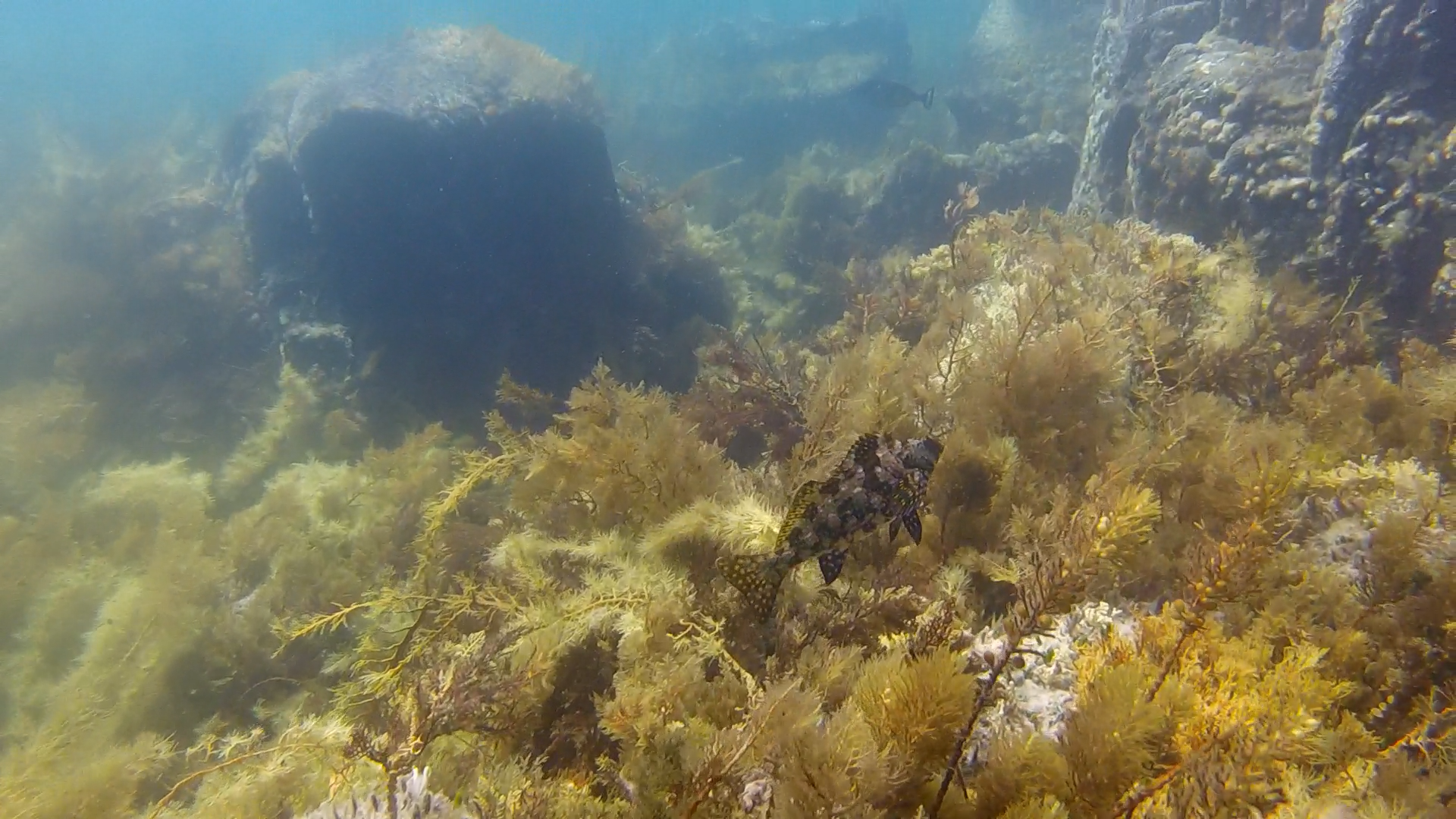
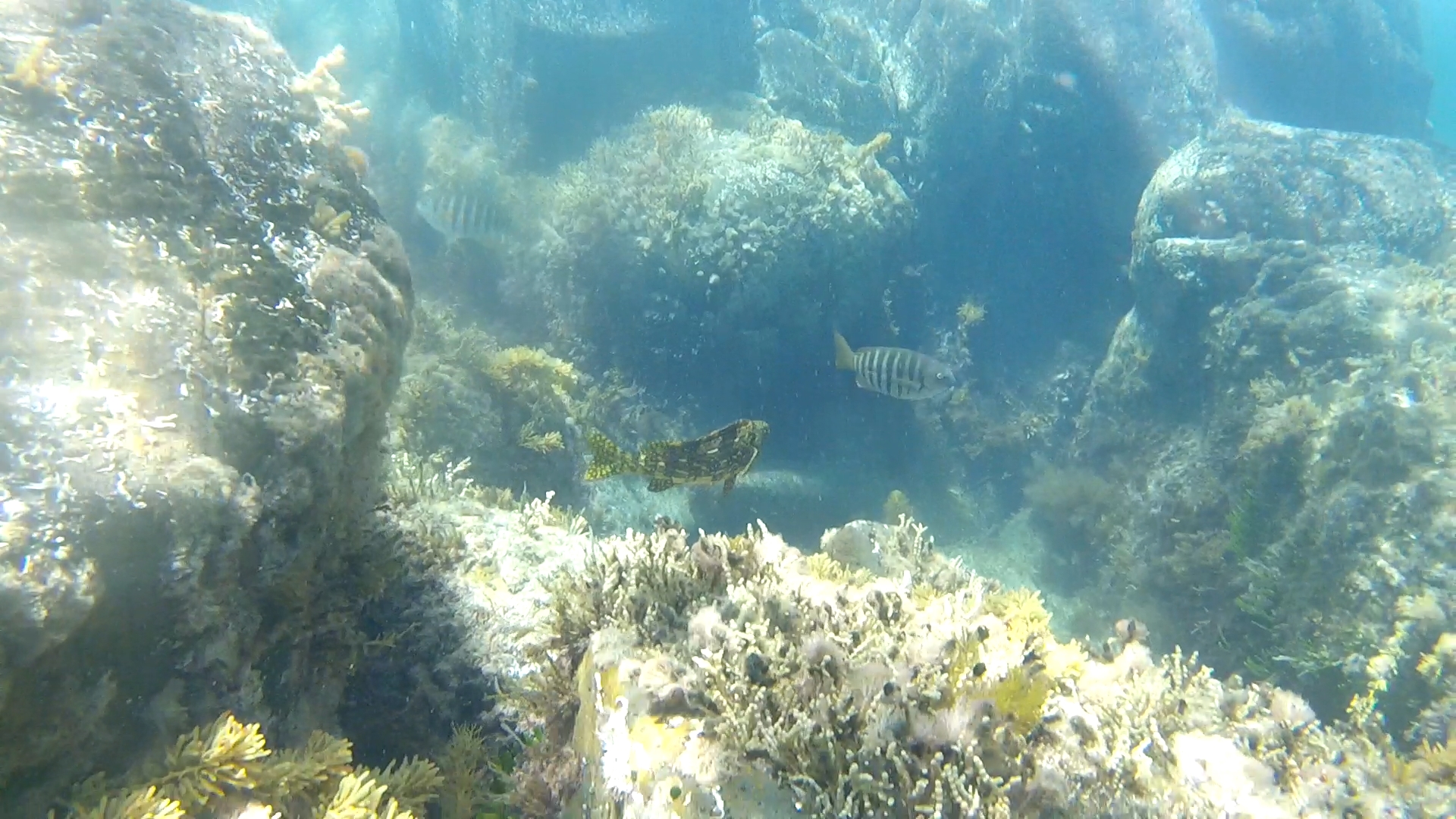
A large greyish to bluish-black fish with pale mottling on the sides, a dark saddle beneath the middle of the spinous dorsal fin, a series of five evenly spaced white dashes or blotches on the sides below the lateral line from above pectoral fin to below end of dorsal fin, and pale spots on the fins.

This species can be confused with the Marble fish (Aplodactylus arctidens) the spots on the tail and fins can help to ID this species along with the 5 bands along the side.

Note:The books and related identification site and apps may state this species is not recorded in Tasmania. Over the recent years this species has been recorded as far south as the Derwent River showing it's recorded range needs adjusting
At a glance

Rock Cale at a glance

Habitat Found on shallow exposed rocky shores, aggregating in high-energy zone, just below foaming surface to depths of about 10 m
Size Grows to around 45cm
Origin Native
Distribution Recorded in Australia from Mudjimba, Sunshine Coast, Queensland, to the Gippsland Lakes, Victoria, and Babel Island, Tasmania
Descriptions
Distribution
Recorded in Australia from Mudjimba, Sunshine Coast, Queensland, to the Gippsland Lakes, Victoria, and Babel Island, Tasmania
Habitat
Found on shallow exposed rocky shores, aggregating in high-energy zone, just below foaming surface to depths of about 10 m
Size
Grows to around 45cm
Common Name Rock Cale
Aliases Cockatoo Fish, Cocky, Joey, Rock Cocky, Sea Carp,
Origin Native
Share
Distribution and map

Distribution provided by The Atlas of Living Australia

Classification

Classification

KingdomAnimalia
PhylumChordata
SubphylumVertebrata
SuperclassGnathostomata
SubclassEuteleostei
SuperorderAcanthopterygii
SuborderPercoidei
Synonyms

Synonyms

There are no known synonyms for this species
References and dates
Original No original text available
Bibliography View page references
Added Thu 4 Jun 2020 @ 00:00 AM
Updated Sun 18 Dec 2022 @ 23:00 PM
Files
Type Details Version Size Added Updated Links
There are no downloads or Files for this species at the moment

Disclaimer: A lot of work goes into trying to identify and ensure accurate identifications are made, and that the listed Descriptions, Sizes, Habitats and Distribution information is as accurate and valid as possible. Unfortunately, information in this arena is ever changing and as such no guarantee can be offered that it is correct or currently valid — the information is provided as a guide, and it is always suggested that you do a little research to ensure you have the latest and most accurate information. View the references or bibliography. Feedback and comments on the information provided are always welcome.