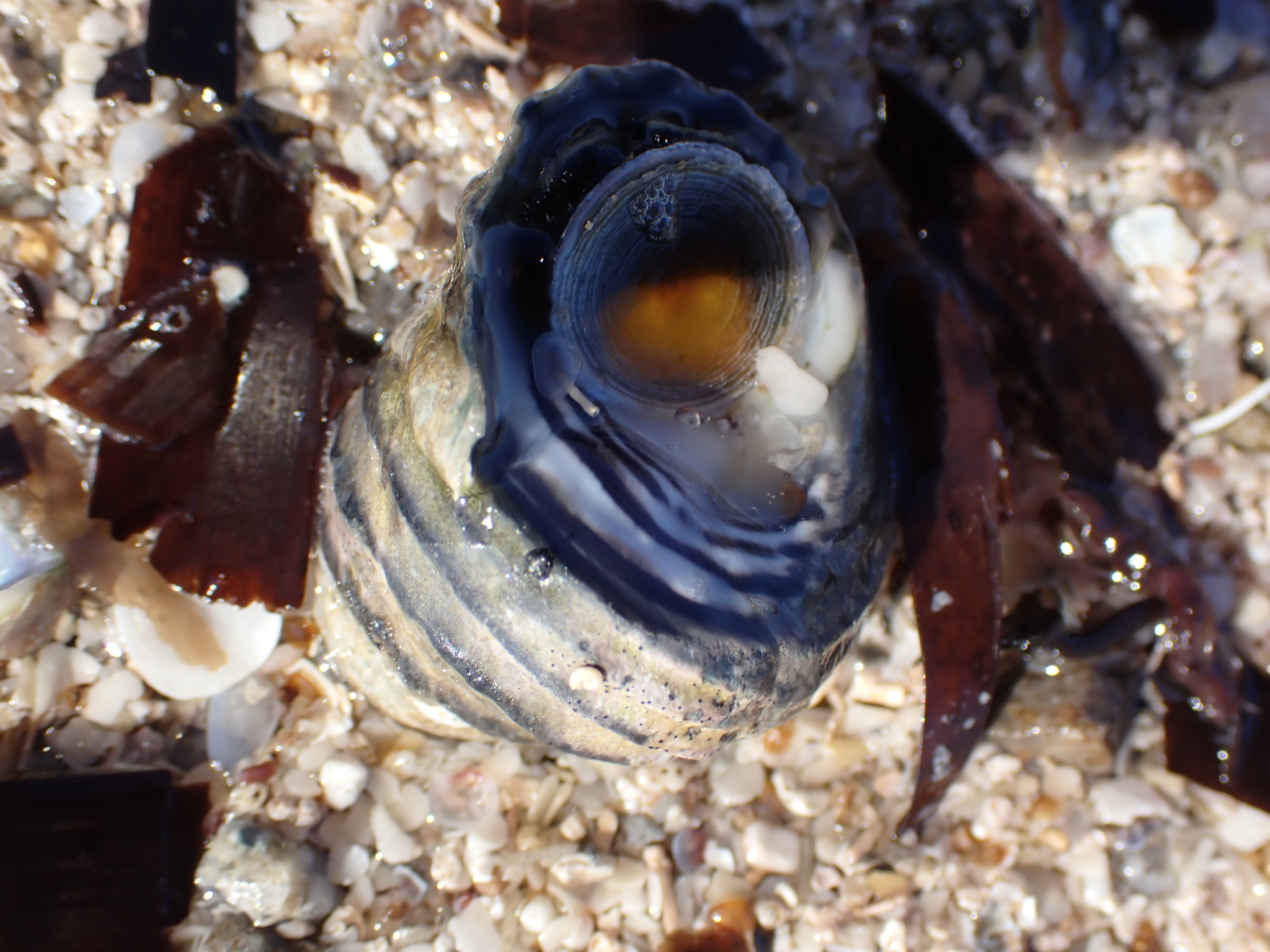
Ribbed Top Shells are often referred to as Periwinkles, but they are not related to the European shells of this name. Other top shells in this genus also live in south-eastern Australia and have various striped and checked patterns. All of them are grazers, feeding on algae
The thick, solid shell is imperforate. Its color is a lusterless ashen or whitish, obscurely marked with black zigzag lines and stripes, or with spiral articulated zones or with spiral stripes of black. Sometimes it is nearly unicolored. The spire is conical with an acute apex. The about five whorls are convex. The first one is eroded, the penultimate is very strongly spirally tricostate. The body whorl has about seven strong carinae. The aperture is oblique. The outer and basal lips are either thick and multilirate within, or rather thin and slightly furrowed at the places of the principal carinae. The short columella is oblique, subdentate at its base and at the insertion spreading in a strong callus upon the parietal wall.
At a glance
Southern Periwinkle at a glance
Habitat
Lives intertidally on mud and among rocks, especially on sheltered shores.
Size
The height of the shell varies between 15 mm and 32 mm, its diameter between 22 mm and 28 mm.
Origin
Endemic
Distribution
This marine species is endemic to Australia and occurs off New South Wales, South Australia, Tasmania, Victoria and Western Australia
Descriptions
Distribution
This marine species is endemic to Australia and occurs off New South Wales, South Australia, Tasmania, Victoria and Western Australia
Habitat
Lives intertidally on mud and among rocks, especially on sheltered shores.
Size
The height of the shell varies between 15 mm and 32 mm, its diameter between 22 mm and 28 mm.
Distribution and map
Distribution provided by The Atlas of Living Australia
Classification
Classification
KingdomAnimalia
PhylumMollusca
ClassGastropoda
SubclassVetigastropoda
SuperfamilyTrochoidea
FamilyTrochidae
SubfamilyMonodontinae
GenusAustrocochlea
SpeciesAustrocochlea constricta
Synonyms
Synonyms
There are no known synonyms for this species
References and dates
Original
No original text available
Bibliography
View page references
Added
Sat 6 Jun 2020 @ 00:00 AM
Updated
Thu 13 May 2021 @ 00:00 AM
Surveys
View Survey List
Photos

Files
External Links
3 External Links
View External
Links
Disclaimer: A lot of work goes into trying to identify and ensure accurate identifications are made, and that the listed Descriptions, Sizes, Habitats and Distribution information is as accurate and valid as possible. Unfortunately, information in this arena is ever changing and as such no guarantee can be offered that it is correct or currently valid — the information is provided as a guide, and it is always suggested that you do a little research to ensure you have the latest and most accurate information. View the references or bibliography. Feedback and comments on the information provided are always welcome.
From Our Tasmania · https://ourtasmania.au/species-guide/view-species/austrocochlea-constricta/