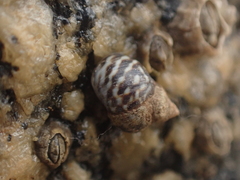
Commonly known as the Little Blue Periwinkle or Blue Australwink, is a small marine snail native to Australia and widespread around Tasmania's rocky coastlines.

This species is commonly found around and above the high-tide mark on exposed rocky shores, where large numbers often gather in cracks, crevices and sheltered depressions. It is well adapted to surviving long periods out of the water, tolerating exposure to sunlight, wind and changing temperatures.

Like other periwinkles, it feeds by grazing on microscopic algae and lichens growing on rock surfaces, becoming more active when the rocks are damp from seawater or sea spray. It is one of the most abundant marine snails found along southern Australia's rocky shores.

At a glance

Blue Australwink at a glance

Habitat Exposed reef and cliff faces around the high tide mark
Size The size range varies between 10 mm and 25 mm
Origin Native
Distribution From Western Australia to Queensland including Tasmania
Descriptions
Distribution
From Western Australia to Queensland including Tasmania
Habitat
Exposed reef and cliff faces around the high tide mark
Size
The size range varies between 10 mm and 25 mm

Identification

A small marine snail with a rounded, cone-shaped shell, typically measuring less than 15 mm in height, although larger individuals can reach around 25 mm. The shell varies in shape, with some individuals appearing short and rounded, while others have a taller, more pointed appearance.

The shell is generally pale blue-grey, becoming lighter towards the upper parts and base. The pointed tip, known as the apex, is usually brown, while the smaller upper whorls may show fine brown spiral lines. Unlike the similar Afrolittorina praetermissa, the shell generally lacks dark brown checkered or mottled markings.

Although the shell appears relatively smooth, closer examination reveals approximately 10–12 fine spiral grooves running around the larger whorl, with weaker grooves towards the base. Even finer grooves may be visible under magnification.

The shell opening, known as the aperture, is usually brown inside, with a distinctive white band near its lower edge. The central inner edge of the opening is also brown, while the outer lip is thin and smooth-looking.

The combination of its pale blue-grey shell, brown pointed tip, fine spiral grooves and brown opening with a white internal band provides useful features for identification.

Common Name Blue Australwink
Aliases Australwinks, Banded Periwinkle, Little Blue Periwinkle,
Origin Native
Conservation No Conservation Status
Share
Distribution and map

Distribution provided by The Atlas of Living Australia

Classification
Synonyms

Synonyms

Littorina unifasciata Gray, 1826
Littorina diemenensis Quoy & Gaimard, 1833
Litorina acuta Menke, 1843
Litorina mauritiana crassior Philippi, 1847
Littorina diemensis Quoy & Gaimard, 1833
Littorina laevis miscellaneous literature
Littorina diemenensis pseudolaevis Nevill, 1885
Melarhaphe mauritiana Lamarck, 1822
Melarhaphe unifasciata (Gray, 1826)
Melarapha diemenensis (Quoy & Gaimard, 1833)
Littorina (Austrolittorina) unifasciata (Gray, 1826)
Littorina (Austrolittorina) unifasciata Gray, 1826
Nodilittorina unifasciata (Gray, 1826)
References and dates
Original No original text available
Bibliography View page references
Added Fri 24 Jul 2020 @ 00:00 AM
Updated Fri 6 Nov 2026 @ 09:26 AM
Files
Type Details Version Size Added Updated Links
There are no downloads or Files for this species at the moment

Disclaimer: A lot of work goes into trying to identify and ensure accurate identifications are made, and that the listed Descriptions, Sizes, Habitats and Distribution information is as accurate and valid as possible. Unfortunately, information in this arena is ever changing and as such no guarantee can be offered that it is correct or currently valid — the information is provided as a guide, and it is always suggested that you do a little research to ensure you have the latest and most accurate information. View the references or bibliography. Feedback and comments on the information provided are always welcome.