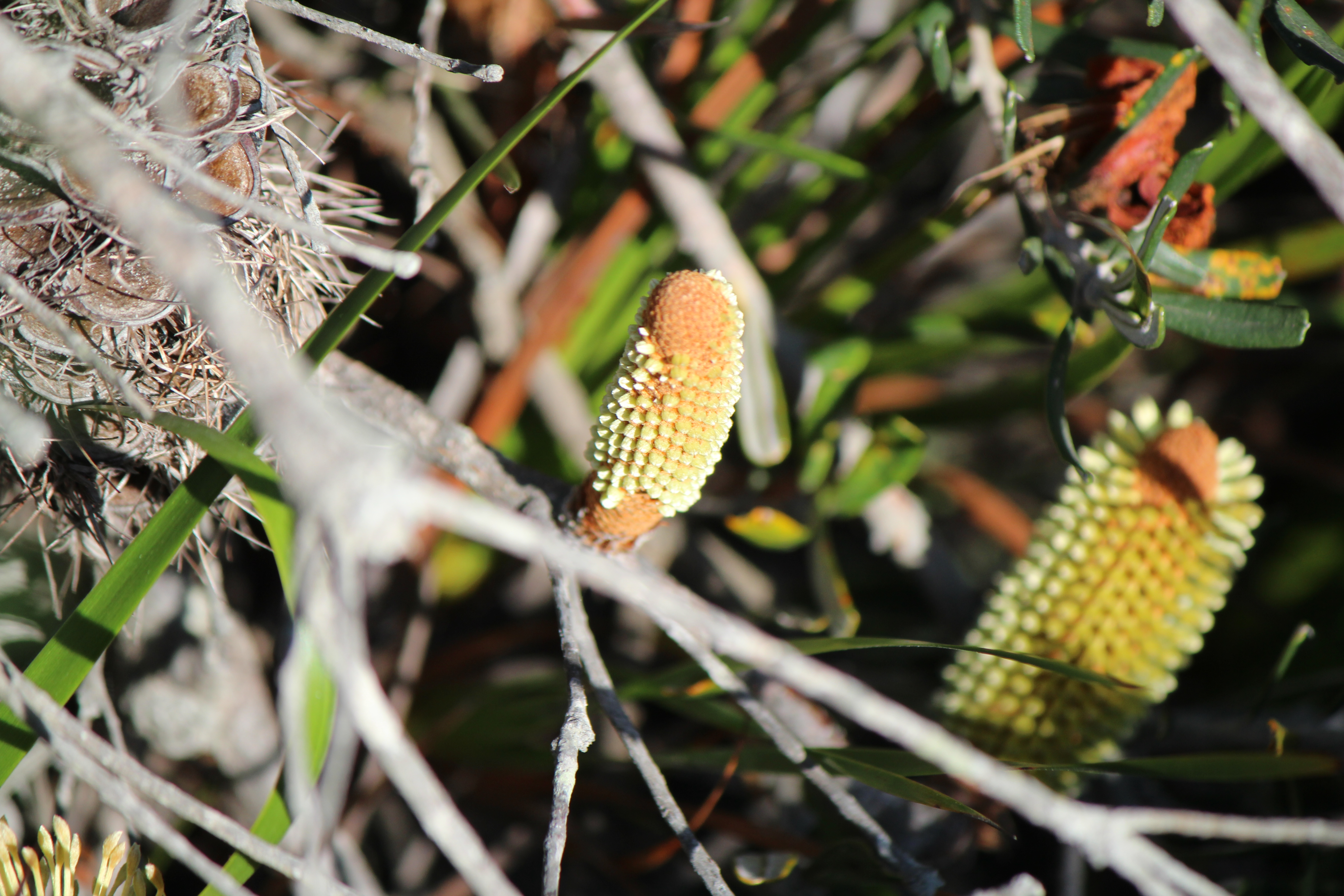
The bark is pale grey and initially smooth before becoming finely tessellated with age. The narrow leaves are linear and the yellow inflorescences (flower spikes) occur from late summer to early winter. The flower spikes fade to brown and then grey and develop woody follicles bearing the winged seeds
Many species of bird, in particular honeyeaters, forage at the flower spikes, as do native and European honeybees. The response to bushfire varies. Some populations are serotinous: they are killed by fire and regenerate from large stores of seed which have been held in cones in the plant canopy and are released after a fire. Others regenerate from underground lignotubers or suckers from lateral roots.
At a glance
Silver Banksia at a glance
Habitat
It grows in various habitats, including Eucalyptus forest, scrub, heathland and moorland
Size
Ranging from a 20-centimetre shrub to a 12-metre tree
Origin
Native
Distribution
It ranges from the Eyre Peninsula in South Australia to north of Armidale, New South Wales, and across Tasmania and the islands of Bass Strait
Descriptions
Distribution
It ranges from the Eyre Peninsula in South Australia to north of Armidale, New South Wales, and across Tasmania and the islands of Bass Strait
Habitat
It grows in various habitats, including Eucalyptus forest, scrub, heathland and moorland
Size
Ranging from a 20-centimetre shrub to a 12-metre tree
Distribution and map
Distribution provided by The Atlas of Living Australia
Classification
Classification
KingdomPlantae
PhylumCharophyta
ClassEquisetopsida
SubclassMagnoliidae
SuperorderProteanae
OrderProteales
FamilyProteaceae
GenusBanksia
SpeciesBanksia marginata
Synonyms
Synonyms
There are no known synonyms for this species
References and dates
Original
No original text available
Bibliography
View page references
Added
Thu 4 Jun 2020 @ 00:00 AM
Updated
Sun 7 Nov 2021 @ 23:00 PM
Surveys
View Survey List
Photos

Files
External Links
1 External Links
View External
Links
Disclaimer: A lot of work goes into trying to identify and ensure accurate identifications are made, and that the listed Descriptions, Sizes, Habitats and Distribution information is as accurate and valid as possible. Unfortunately, information in this arena is ever changing and as such no guarantee can be offered that it is correct or currently valid — the information is provided as a guide, and it is always suggested that you do a little research to ensure you have the latest and most accurate information. View the references or bibliography. Feedback and comments on the information provided are always welcome.
From Our Tasmania · https://ourtasmania.au/species-guide/view-species/banksia-marginata/