Introduced to Tasmania from WA as a garden plant this species is now considered a significant weed In Tasmania and many other states.
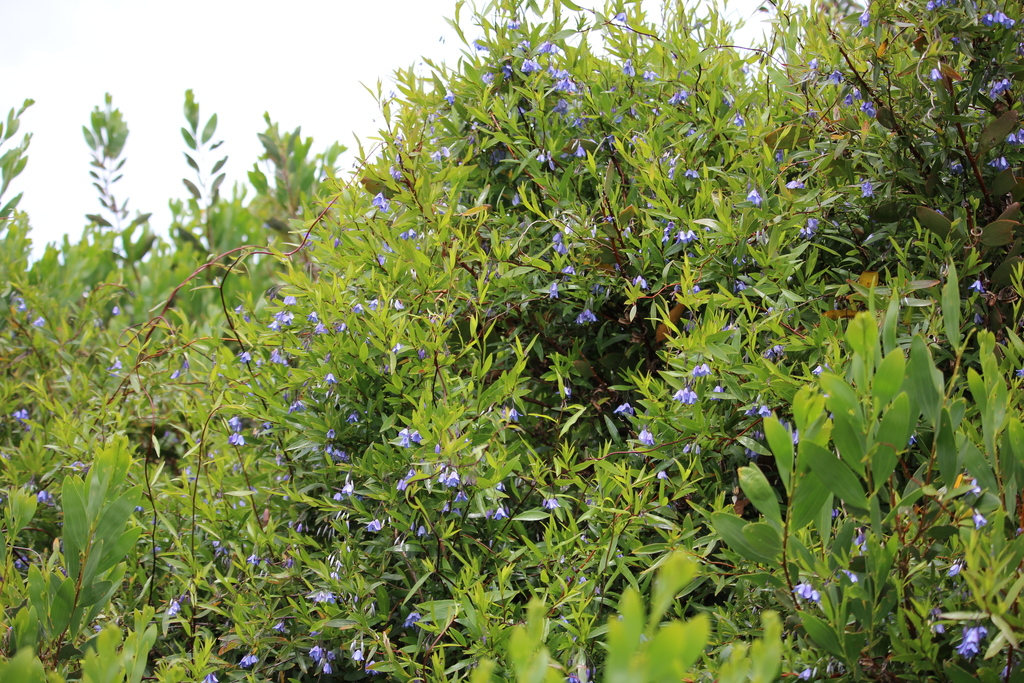
It is a long-lived climbing plant which is rarely bushy in habit. New stems are greenish in colour and densely hairy, while older stems are reddish brown. The long leaves are almost stalkless, have entire margins and are softly hairy. The nodding blue flowers occur in small clusters at the branch tips. These flowers have five petals and five yellowish stamens which are pressed to each other
This plant is listed as "Native" as it is an Australian native plant however it is not native to Tasmania and whilst can be considered a native it can be harmful to Tasmanian native environments.
At a glance
Bluebell Creeper at a glance
Habitat
Coastal areas and disturbed areas often coming back fast after fires out growing locally native species
Size
Can grow to around 4m high and 4m wide often growing over and smothering other plants
Origin
Native
Distribution
Endemic to WA it is considered an wide spread weed in Tasmania, Victoria, South Australia, New South Wales and the ACT
Descriptions
Distribution
Endemic to WA it is considered an wide spread weed in Tasmania, Victoria, South Australia, New South Wales and the ACT
Habitat
Coastal areas and disturbed areas often coming back fast after fires out growing locally native species
Size
Can grow to around 4m high and 4m wide often growing over and smothering other plants
Distribution and map
Distribution provided by The Atlas of Living Australia
Classification
Classification
KingdomPlantae
PhylumCharophyta
ClassEquisetopsida
SubclassMagnoliidae
SuperorderAsteranae
OrderApiales
FamilyPittosporaceae
GenusBillardiera
SpeciesBillardiera heterophylla
Synonyms
Synonyms
There are no known synonyms for this species
References and dates
Original
No original text available
Bibliography
View page references
Added
Wed 23 Dec 2020 @ 23:00 PM
Updated
Sun 7 Nov 2021 @ 23:00 PM
Surveys
View Survey List
Photos
Files
External Links
3 External Links
View External
Links
Disclaimer: A lot of work goes into trying to identify and ensure accurate identifications are made, and that the listed Descriptions, Sizes, Habitats and Distribution information is as accurate and valid as possible. Unfortunately, information in this arena is ever changing and as such no guarantee can be offered that it is correct or currently valid — the information is provided as a guide, and it is always suggested that you do a little research to ensure you have the latest and most accurate information. View the references or bibliography. Feedback and comments on the information provided are always welcome.
From Our Tasmania · https://ourtasmania.au/species-guide/view-species/billardiera-heterophylla/