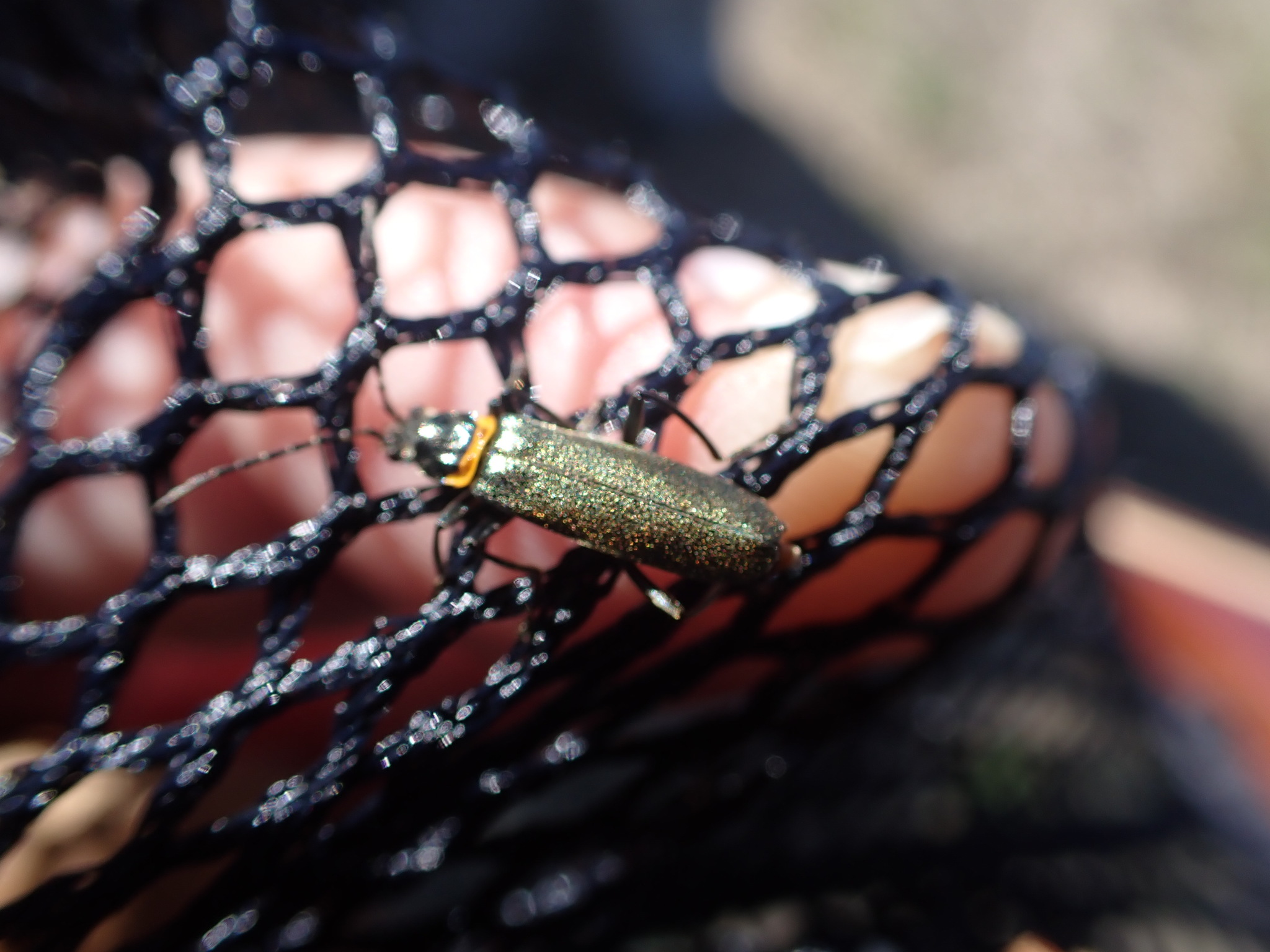
Body flat with yellow-orange stripe behind the head (around back of pronotum). Wings cases (elytra) dark green, covering a yellow-orange abdomen. Head and legs black. Plague Soldier Beetles form huge swarms of mating beetles in late summer. They visit flowers and are thought to feed on nectar, pollen and soft-bodied invertebrates. Their larvae live in the soil and eat soft-bodied invertebrates.
The soldier beetle also secretes the same chemical in a wax form to protect it’s eggs against infection.
Researchers have recently found the genes that give the chemical its anti-microbial and anti-cancer properties, and were able to replicate the synthesis in the lab. This may one day lead to the development of new anti-biotic and anti-cancer related products.
At a glance
Plague Soldier Beetle at a glance
Habitat
Woodlands, dry sclerophyll forests and gardens
Size
Body up to 2 cm long
Origin
Native
Distribution
South-eastern mainland Australia and Tasmania
Descriptions
Distribution
South-eastern mainland Australia and Tasmania
Habitat
Woodlands, dry sclerophyll forests and gardens
Size
Body up to 2 cm long
Distribution and map
Distribution provided by The Atlas of Living Australia
Classification
Classification
KingdomAnimalia
PhylumArthropoda
SubphylumHexapoda
ClassInsecta
SubclassPterygotes
OrderColeoptera
SuborderPolyphaga
SuperfamilyElateroidea
FamilyCantharidae
SubfamilyChauliognathinae
GenusChauliognathus
SpeciesChauliognathus lugubris
Synonyms
Synonyms
There are no known synonyms for this species
References and dates
Original
No original text available
Bibliography
View page references
Added
Tue 8 Dec 2020 @ 23:00 PM
Updated
Sun 25 Sep 2022 @ 00:00 AM
Surveys
View Survey List
Photos
Files
External Links
3 External Links
View External
Links
Disclaimer: A lot of work goes into trying to identify and ensure accurate identifications are made, and that the listed Descriptions, Sizes, Habitats and Distribution information is as accurate and valid as possible. Unfortunately, information in this arena is ever changing and as such no guarantee can be offered that it is correct or currently valid — the information is provided as a guide, and it is always suggested that you do a little research to ensure you have the latest and most accurate information. View the references or bibliography. Feedback and comments on the information provided are always welcome.
From Our Tasmania · https://ourtasmania.au/species-guide/view-species/chauliognathus-lugubris/