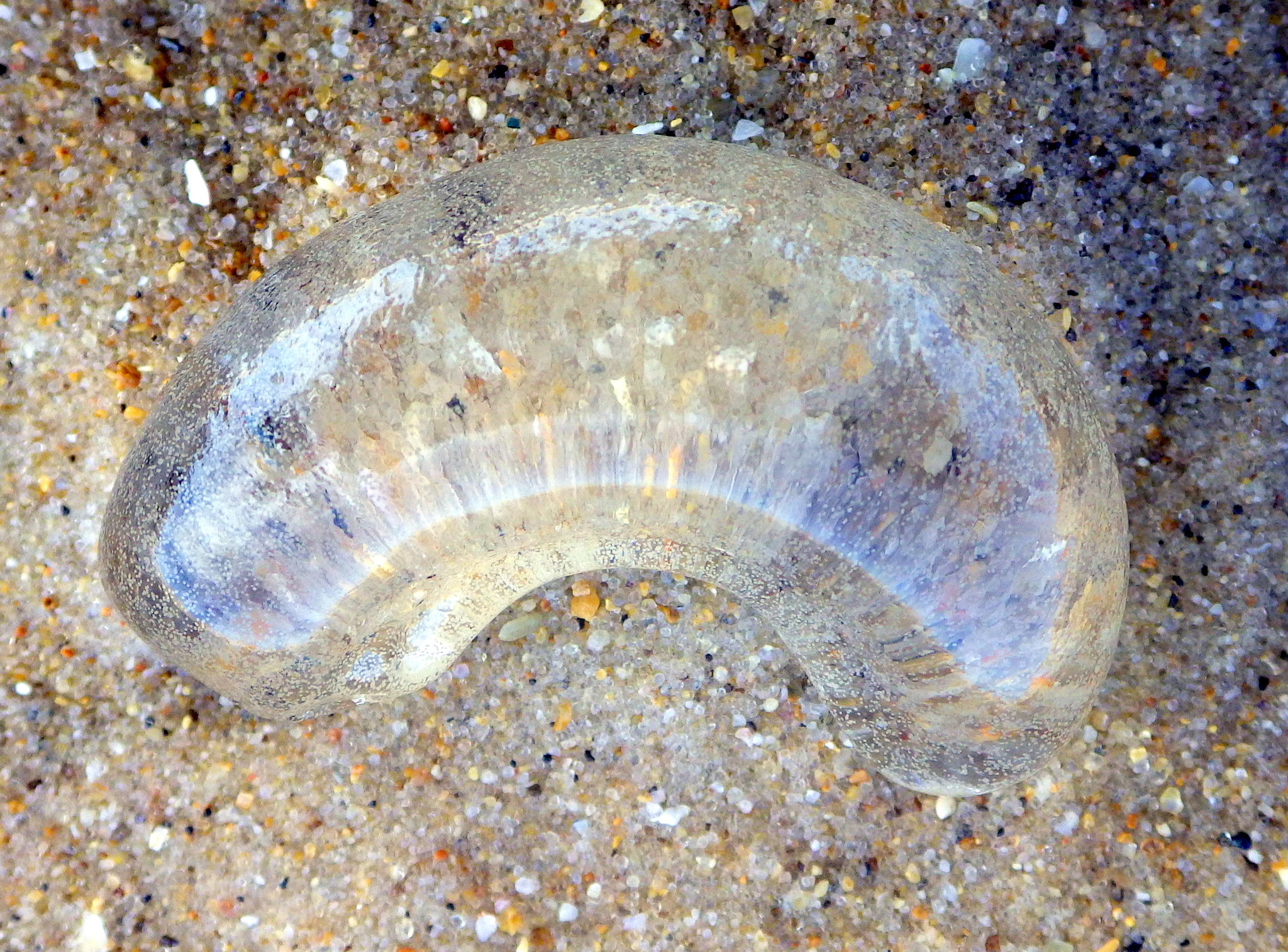
Moon Snails leave trails behind them as they move across sand at low tide. Like all snails in this family, they are predators, eating bivalves and other sea snails by drilling a hole into the shell, using their rough radular and acid, through which they extract the soft body. These holes have a distinctive countersunk shape, being narrower at the bottom than the top. While drilling, the Moon Snail holds its prey in its large, muscular foot to prevent it escaping. Females lay 'C' shape egg masses in a stiff jelly, which are often mistaken for jellyfish

At a glance

Conical Moon Snail at a glance

Habitat Intertidal sand flats
Size Can grow up to around 53mm
Origin Native
Distribution Mainland Australia and Tasmania
Descriptions
Distribution
Mainland Australia and Tasmania
Habitat
Intertidal sand flats
Size
Can grow up to around 53mm
Common Name Conical Moon Snail
Aliases No Known Aliases
Origin Native
Share
Distribution and map

Distribution provided by The Atlas of Living Australia

Classification

Classification

KingdomAnimalia
PhylumMollusca
SuperorderSorbeoconcha
SuperfamilyNaticoidea
FamilyNaticidae
SubfamilyNaticinae
GenusConuber
Synonyms

Synonyms

There are no known synonyms for this species
References and dates
Original No original text available
Bibliography View page references
Added Fri 24 Jul 2020 @ 00:00 AM
Updated Thu 13 May 2021 @ 00:00 AM
Files
Type Details Version Size Added Updated Links
There are no downloads or Files for this species at the moment

Disclaimer: A lot of work goes into trying to identify and ensure accurate identifications are made, and that the listed Descriptions, Sizes, Habitats and Distribution information is as accurate and valid as possible. Unfortunately, information in this arena is ever changing and as such no guarantee can be offered that it is correct or currently valid — the information is provided as a guide, and it is always suggested that you do a little research to ensure you have the latest and most accurate information. View the references or bibliography. Feedback and comments on the information provided are always welcome.