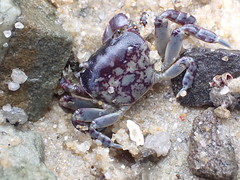
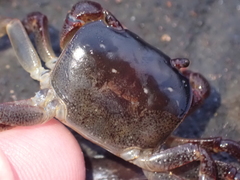
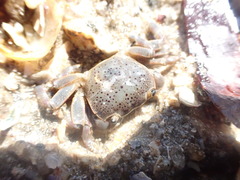
This crab looks much like the notched shore crab (Paragrapsus quadridentatus). The key differences are the carapace lacks the spots, the legs are slightly thinner and the front of the carapace is more rounded downwards. Apart from this the crab has the single notch behind each of the eyes.
These crabs live in the mud or sand digging borrows in estuaries above the high tide level, these borrows can be interconnecting. Theses crabs can also withstand high levels of pollution so can be found in areas of run off where other crabs cannot be found.
At a glance
Haswell's Shore Crab at a glance
Habitat
Can be found under rocks and in burrows at mid to high tide levels
Size
Can grow to around 30mm across the carapace
Origin
Endemic
Distribution
South-eastern Australia including around Tasmania
Descriptions
Distribution
South-eastern Australia including around Tasmania
Habitat
Can be found under rocks and in burrows at mid to high tide levels
Size
Can grow to around 30mm across the carapace
Similar Species


Distribution and map
Distribution provided by The Atlas of Living Australia
Classification
Classification
KingdomAnimalia
PhylumArthropoda
SubphylumCrustacea
SuperclassMulticrustacea
ClassMalacostraca
SubclassEumalacostraca
SuperorderEucarida
OrderDecapoda
SuborderPleocyemata
InfraorderBrachyura
SectionEubrachyura
SuperfamilyGrapsoidea
FamilyVarunidae
SubfamilyCyclograpsinae
GenusHelograpsus
SpeciesHelograpsus haswellianus
Synonyms
Synonyms
There are no known synonyms for this species
References and dates
Original
No original text available
Bibliography
View page references
Added
Fri 9 Jul 2021 @ 00:00 AM
Updated
Sat 19 Sep 2026 @ 10:19 AM
Surveys
View Survey List
Photos
No images found for this species
Files
External Links
3 External Links
View External
Links
Disclaimer: A lot of work goes into trying to identify and ensure accurate identifications are made, and that the listed Descriptions, Sizes, Habitats and Distribution information is as accurate and valid as possible. Unfortunately, information in this arena is ever changing and as such no guarantee can be offered that it is correct or currently valid — the information is provided as a guide, and it is always suggested that you do a little research to ensure you have the latest and most accurate information. View the references or bibliography. Feedback and comments on the information provided are always welcome.
From Our Tasmania · https://ourtasmania.au/species-guide/view-species/helograpsus-haswellianus/