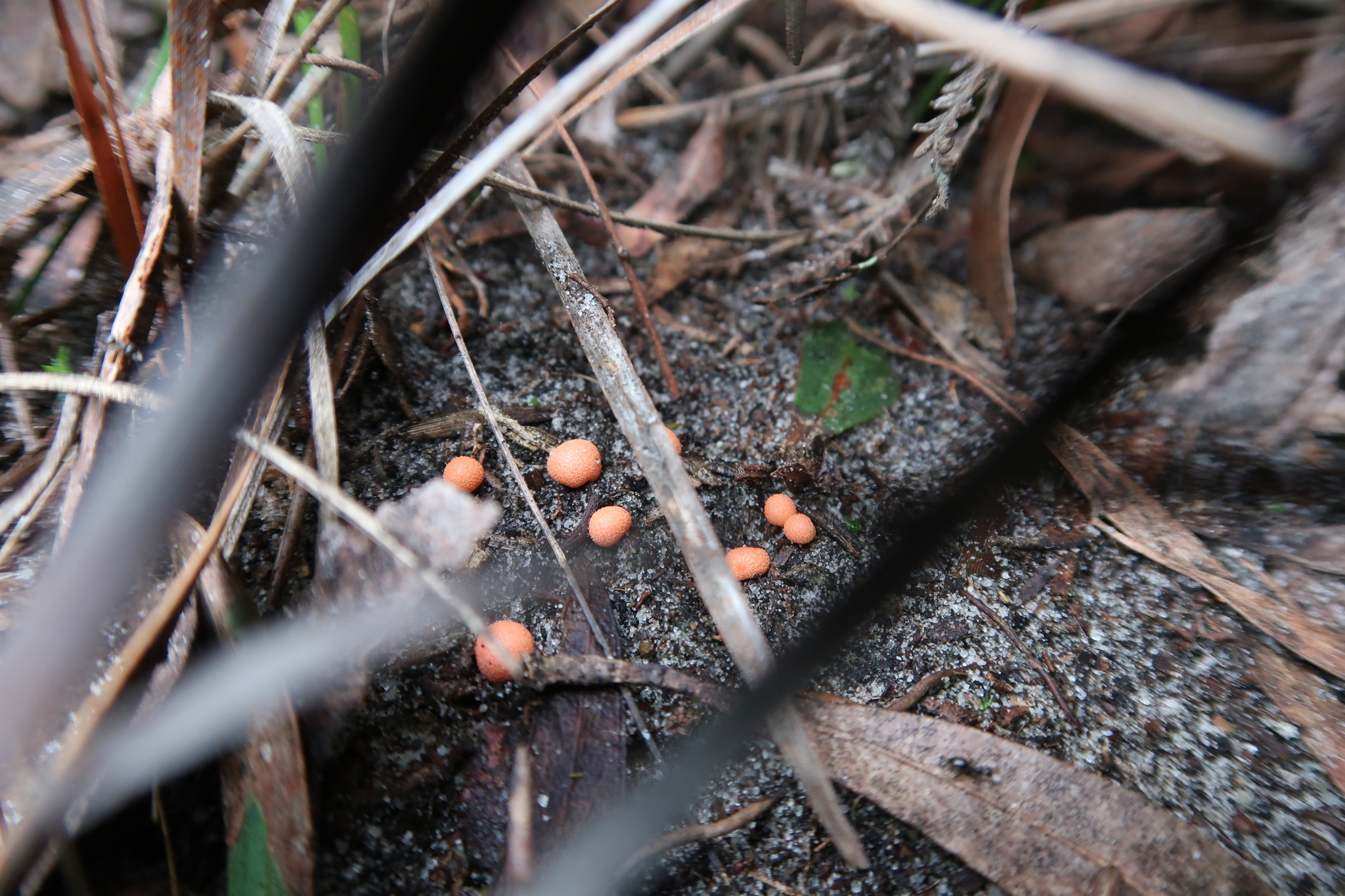
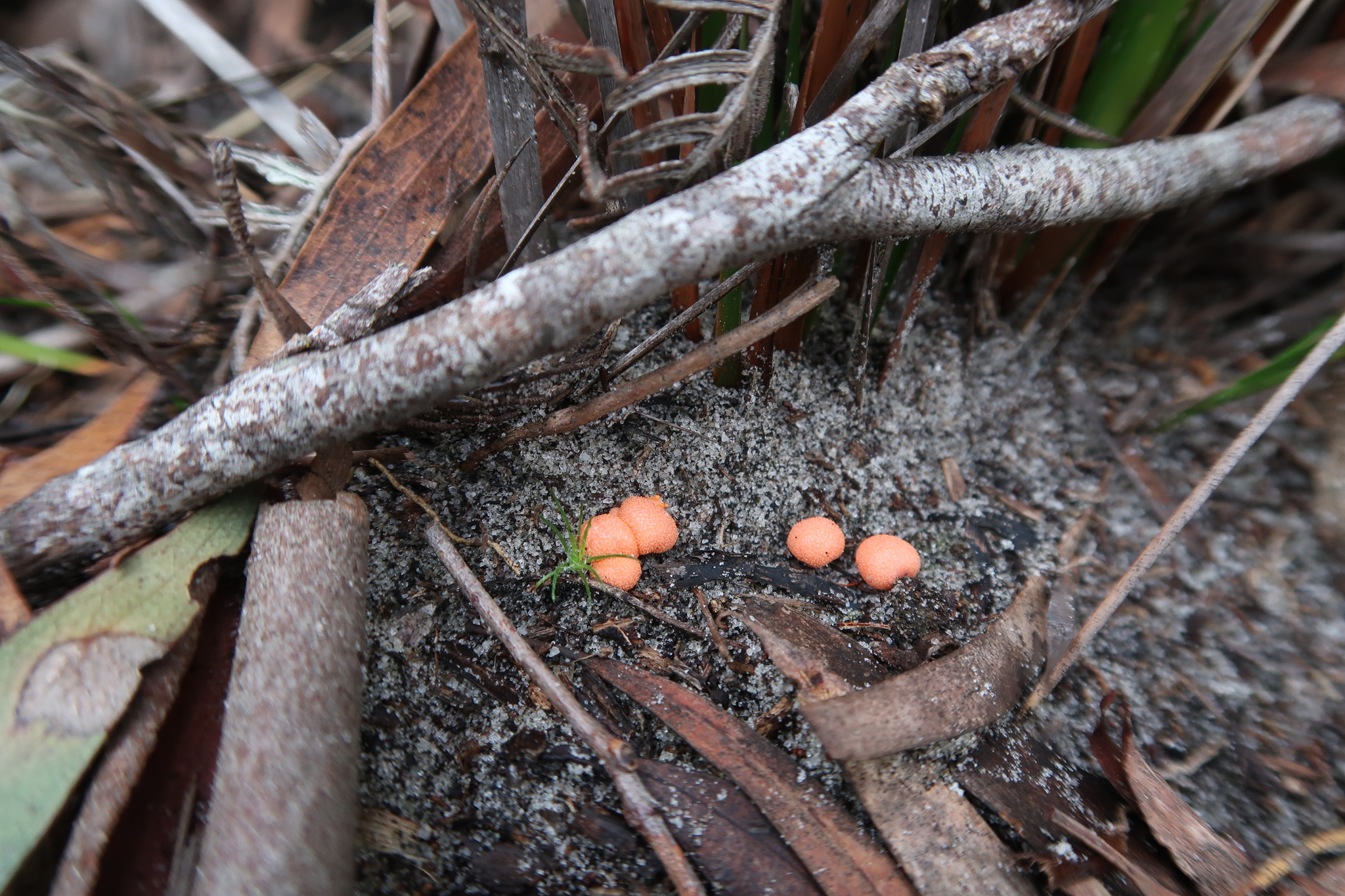
A small slime mold that grows on top of rotting wood. The colour varies greatly and changes as the slime mold matures at first pinkish-gray to bright cinnabar-red when young. At this stage the flesh is a pinkish, paste-like substance (like toothpaste?). With maturity the fruit body becomes yellow-brown or olive-brown and the spore mass becomes powdery and pinkish-gray to ochre in mass.
Note: This non edible species is not a fungus or mushroom It belongs to a group called slime molds, or myxomycetes—a group of funguslike organisms that at one time were regarded as animals, then thought to be plants, then fungi. Now, because of DNA studies, slime molds are believed to be closer to the protozoa. They are studied by botanists and mycologists. Included here as I do not have a better grouping for it
At a glance
Wolf's-Milk Slime at a glance
Habitat
Scattered to clustered on well-rotted wood
Size
This slime mold forms fruit bodies 3-15 mm wide.
Origin
Native
Distribution
world wide
Descriptions
Distribution
world wide
Habitat
Scattered to clustered on well-rotted wood
Size
This slime mold forms fruit bodies 3-15 mm wide.
Distribution and map
Distribution provided by The Atlas of Living Australia
Classification
Classification
KingdomProtista
PhylumAmoebozoa
SubphylumMycetozoa
ClassMyxogastrea
OrderLiceida
FamilyTubiferaceae
GenusLycogala
SpeciesLycogala epidendrum
Synonyms
Synonyms
There are no known synonyms for this species
References and dates
Original
No original text available
Bibliography
View page references
Added
Mon 8 Nov 2021 @ 23:00 PM
Updated
Fri 5 Aug 2022 @ 00:00 AM
Surveys
View Survey List
Photos
Files
External Links
0 External Links
View External
Links
Disclaimer: A lot of work goes into trying to identify and ensure accurate identifications are made, and that the listed Descriptions, Sizes, Habitats and Distribution information is as accurate and valid as possible. Unfortunately, information in this arena is ever changing and as such no guarantee can be offered that it is correct or currently valid — the information is provided as a guide, and it is always suggested that you do a little research to ensure you have the latest and most accurate information. View the references or bibliography. Feedback and comments on the information provided are always welcome.
From Our Tasmania · https://ourtasmania.au/species-guide/view-species/lycogala-epidendrum/