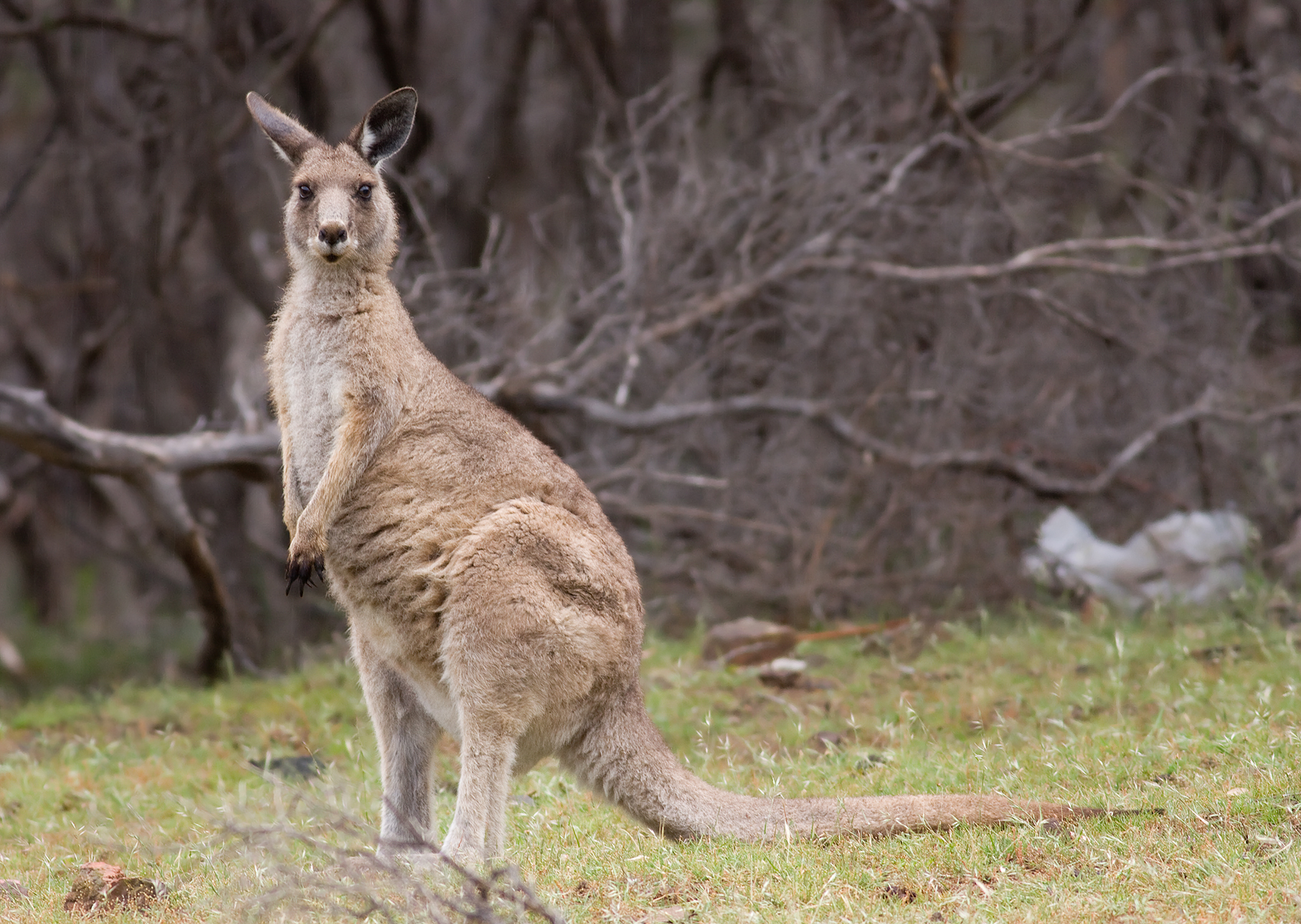
It is the largest marsupial in Tasmania and the second largest in the world. Colour varies from light brownish grey in males to grey in females. They differ from other Tasmanian macropods due to their large size, thick tail and relatively large ears. They often make clucking sounds between themselves and give a guttural cough when alarmed
The Mt William National Park in the northeast provides the opportunity to see these animals along 'Forester Drive'. A drive, or stroll along this road at dusk is most rewarding. The Forester has also been introduced to Maria Island National Park and Narawntapu National Park. Preferred habitat is open grassy forests and woodlands of northeastern and central Tasmania.
The Forester kangaroo is protected wildlife
At a glance
Forester kangaroo at a glance
Habitat
It inhabits coastal areas, woodlands, forests, mountain forests, and inland scrubs
Size
Adult males can reach over 60 kg and stand around 2 meters tall
Origin
Endemic
Distribution
This species is common on mianland Australia, where it is commonly known as the grey kangaroo. However in Tasmania The Forester kangaroo is currently restricted to a number of isolated populations in central and northeastern Tasmania.
Descriptions
Distribution
This species is common on mianland Australia, where it is commonly known as the grey kangaroo. However in Tasmania The Forester kangaroo is currently restricted to a number of isolated populations in central and northeastern Tasmania.
Habitat
It inhabits coastal areas, woodlands, forests, mountain forests, and inland scrubs
Size
Adult males can reach over 60 kg and stand around 2 meters tall
Distribution and map
Distribution provided by The Atlas of Living Australia
Classification
Classification
KingdomAnimalia
PhylumChordata
SubphylumVertebrata
SuperclassGnathostomata
ClassMammalia
SubclassMarsupialia
OrderDiprotodontia
SuborderPhalangerida
SuperfamilyMacropodoidea
FamilyMacropodidae
SubfamilyMacropodinae
GenusMacropus
SpeciesMacropus giganteus
Synonyms
Synonyms
There are no known synonyms for this species
References and dates
Original
No original text available
Bibliography
View page references
Added
Sat 6 Jun 2020 @ 00:00 AM
Updated
Tue 16 Nov 2021 @ 23:00 PM
Surveys
View Survey List
Photos
Files
External Links
2 External Links
View External
Links
Disclaimer: A lot of work goes into trying to identify and ensure accurate identifications are made, and that the listed Descriptions, Sizes, Habitats and Distribution information is as accurate and valid as possible. Unfortunately, information in this arena is ever changing and as such no guarantee can be offered that it is correct or currently valid — the information is provided as a guide, and it is always suggested that you do a little research to ensure you have the latest and most accurate information. View the references or bibliography. Feedback and comments on the information provided are always welcome.
From Our Tasmania · https://ourtasmania.au/species-guide/view-species/macropus-giganteus/