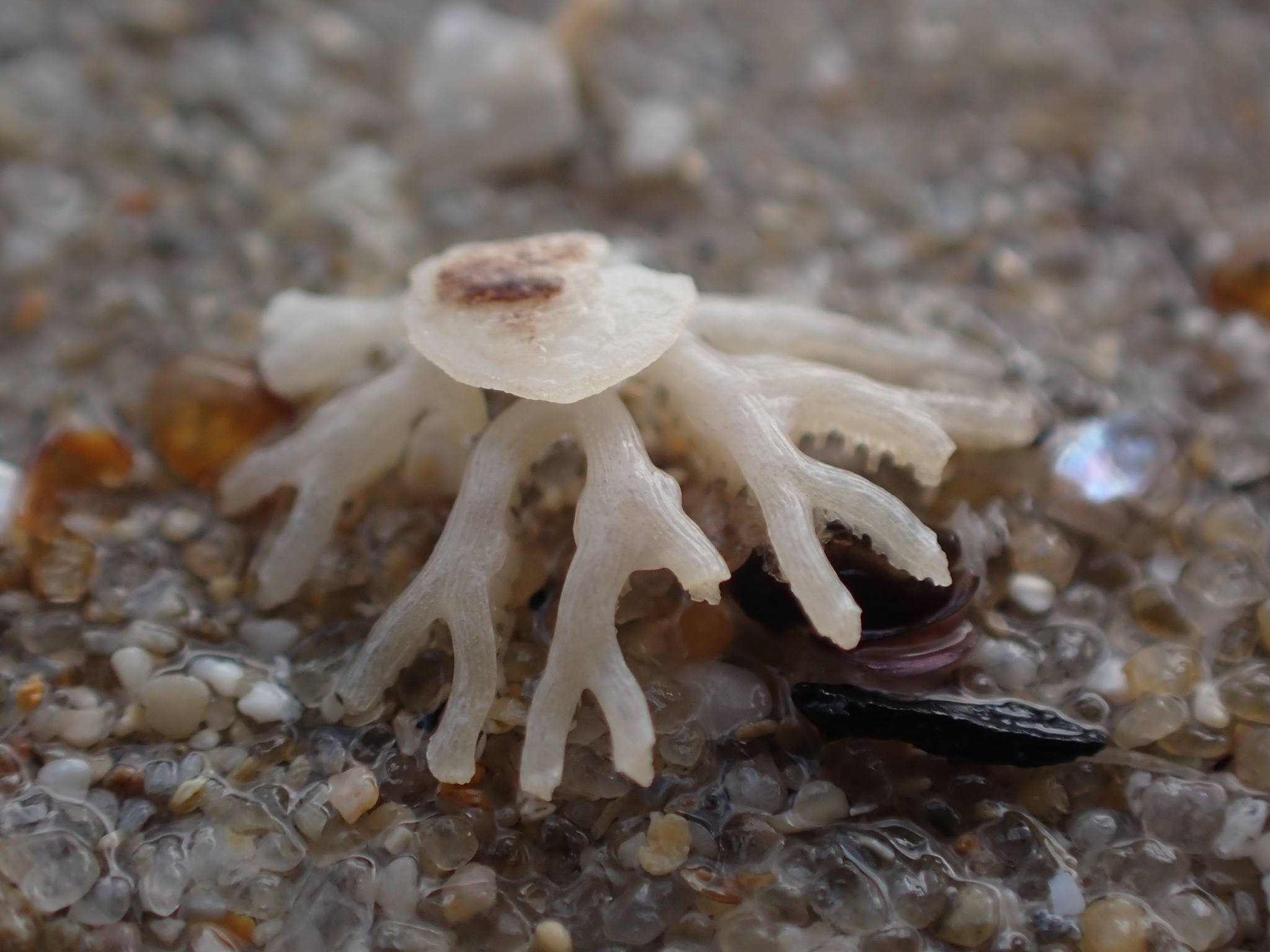
Like other bryozoans, it is a colonial animal made up of many tiny individuals living together. These form delicate, branching, fan-like colonies supported by a hard, calcium-based skeleton. The individual animals feed by filtering tiny food particles from the surrounding seawater.

The species is often found growing attached to seaweeds in shallow coastal waters, although it has also been recorded at depths greater than 100 metres.

While Mesonea radians has historically been reported from several regions outside Australia, some of these records are now considered to represent other, closely related species. Further research is needed to establish its full distribution.
At a glance

Tuning Fork Bryozoan at a glance

Habitat Can be found growing on marine algae and rocks to depth greater than 100m
Size varible
Origin Native
Distribution Found around Australia however distribution needs further research
Descriptions
Distribution
Found around Australia however distribution needs further research
Habitat
Can be found growing on marine algae and rocks to depth greater than 100m
Size
varible

Identification

Mesonea radians forms delicate, upright, fan-shaped colonies made up of numerous thin, branching structures that spread outwards from a small attachment point. Larger colonies can develop a broader, cone-like appearance as the branches continue to spread and divide. The colony has a hard but fragile, calcium-based skeleton and varies in colour from white to purple, often with uneven patches of purple colouring.

The branches repeatedly divide into two, creating a distinctive radiating pattern. Along the front of each branch is a raised central ridge, with tiny tubular openings arranged in short rows that alternate from one side to the other. These openings house the individual animals, known as zooids, that make up the colony.

The reverse side of each branch has fine grooves running along its length, while the front is covered in numerous tiny pores. Some branches also develop larger, raised reproductive chambers, known as gonozooids, which are generally positioned close to where the branches divide.

The combination of its delicate, radiating fan shape, patchy purple colouration and regularly arranged tubular openings provides useful features for identification. However, closer examination under magnification is generally needed to confirm the species.

Common Name Tuning Fork Bryozoan
Aliases No Known Aliases
Origin Native
Conservation No Conservation Status
Tags
Share
Distribution and map

Distribution provided by The Atlas of Living Australia

Classification

Classification

KingdomAnimalia
PhylumBryozoa
SuborderCancellina
GenusMesonea
Synonyms

Synonyms

Retepora radians Lamarck, 1816
Crisina radians Lamarck, 1816
References and dates
Original No original text available
Bibliography View page references
Added Tue 3 Nov 2026 @ 10:45 AM
Updated Tue 3 Nov 2026 @ 10:57 AM
Files
Type Details Version Size Added Updated Links
There are no downloads or Files for this species at the moment

Disclaimer: A lot of work goes into trying to identify and ensure accurate identifications are made, and that the listed Descriptions, Sizes, Habitats and Distribution information is as accurate and valid as possible. Unfortunately, information in this arena is ever changing and as such no guarantee can be offered that it is correct or currently valid — the information is provided as a guide, and it is always suggested that you do a little research to ensure you have the latest and most accurate information. View the references or bibliography. Feedback and comments on the information provided are always welcome.