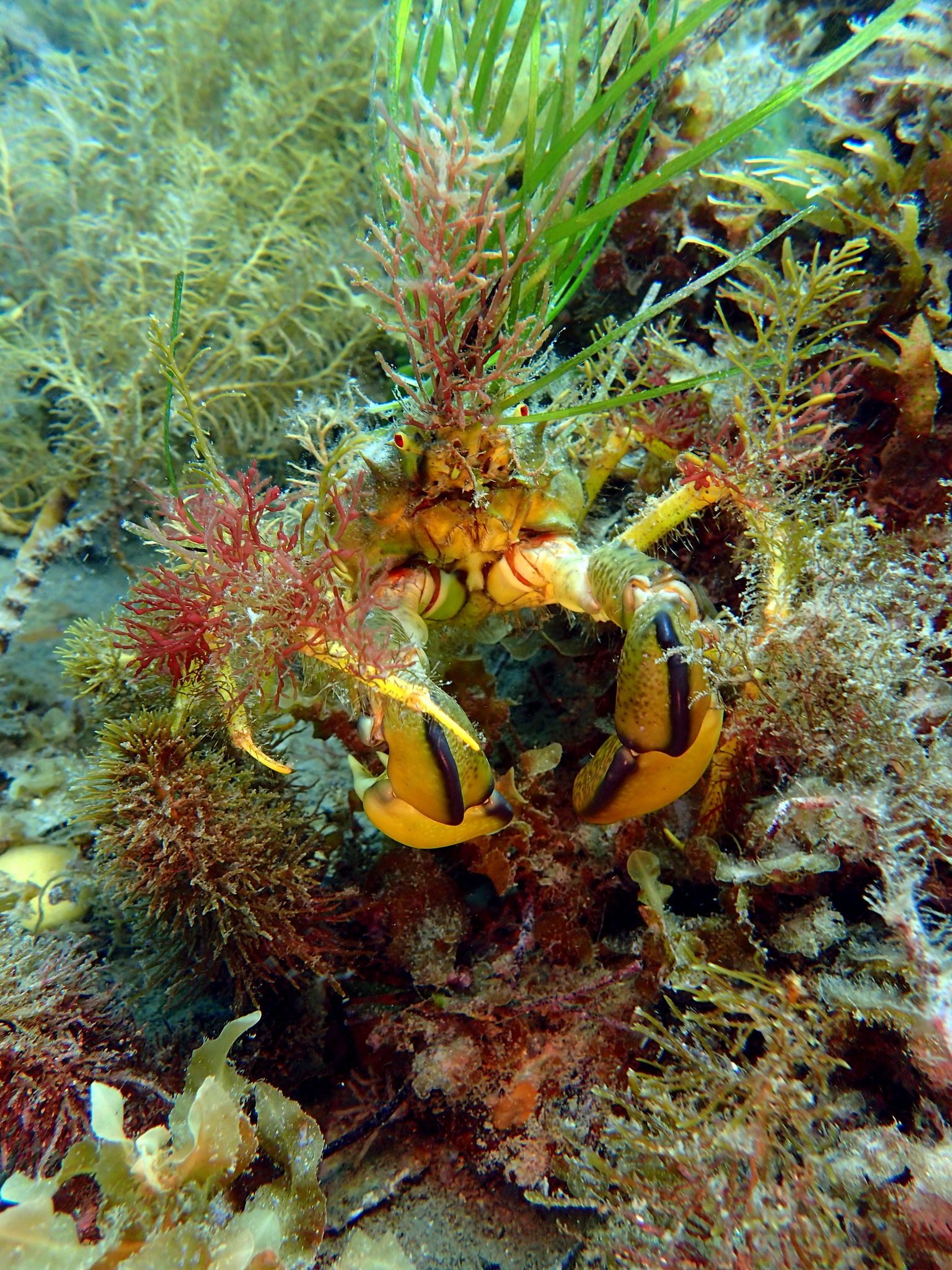
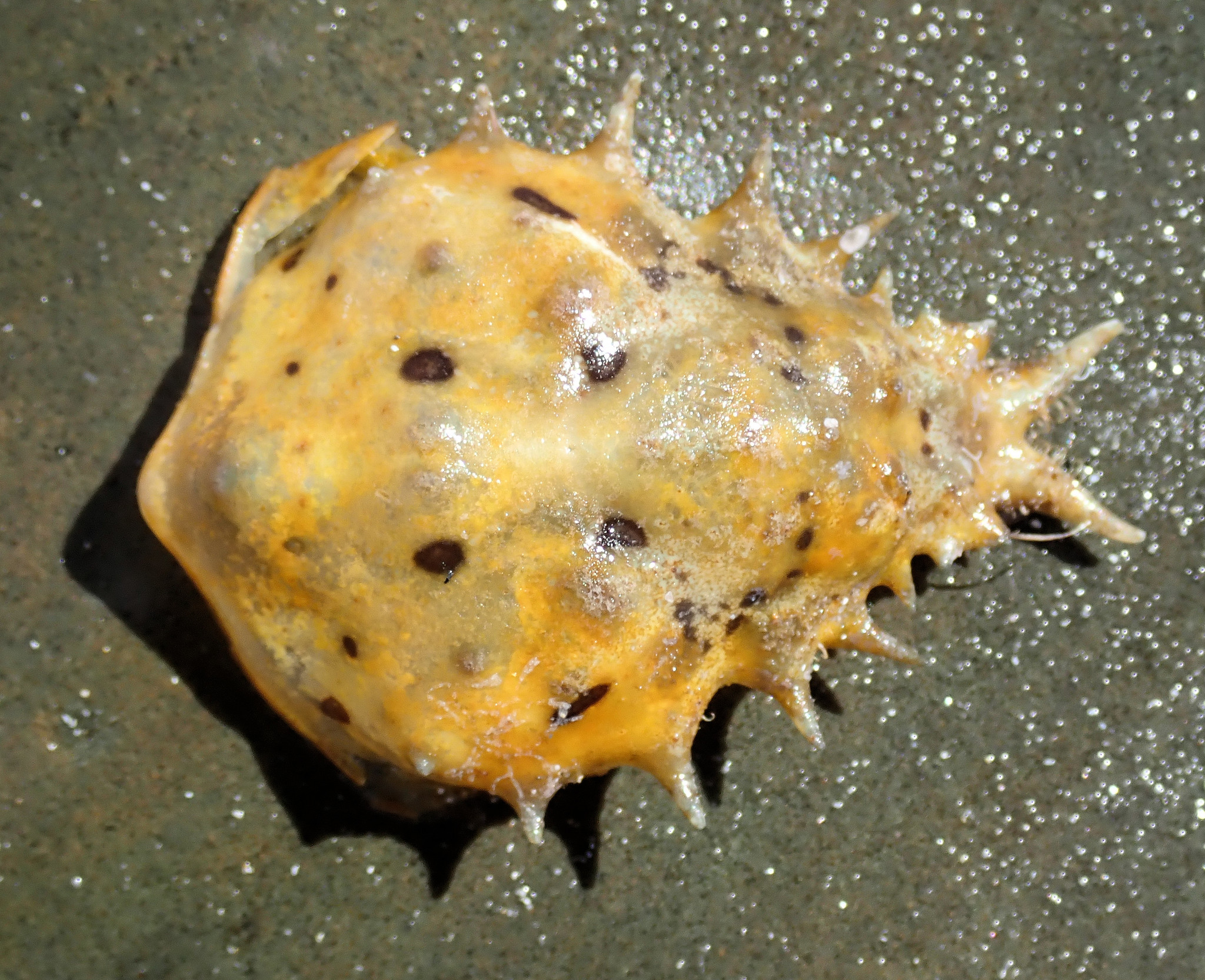
This common spider crab has a loosely pear shaped yellow to brown shell that features stout rostral spines (spines near the front) that are straight but at a slight divergent angle. The chelipeds (legs with claws) feature a blue or dark trim along the outer edge and have an organge accent. The walking legs are thin and long with hairs.
These crabs attach seaweeds, sponges and bryozoan to the small hairs on their carapace and legs to act as a camouflage, making them good at hiding within the enviroments they live in.
At a glance
Golden Decorator Crab at a glance
Habitat
Can be found in seaweed (algal) beds and reef structure out to a depth of 108m
Size
Can grow to around 70mm in the length of the carapace
Origin
Native
Distribution
Southern temperate oceans, including around southern Australia
Descriptions
Distribution
Southern temperate oceans, including around southern Australia
Habitat
Can be found in seaweed (algal) beds and reef structure out to a depth of 108m
Size
Can grow to around 70mm in the length of the carapace
Distribution and map
Distribution provided by The Atlas of Living Australia
Classification
Classification
KingdomAnimalia
PhylumArthropoda
SubphylumCrustacea
SuperclassMulticrustacea
ClassMalacostraca
SubclassEumalacostraca
SuperorderEucarida
OrderDecapoda
SuborderPleocyemata
InfraorderBrachyura
SectionEubrachyura
SuperfamilyMajoidea
FamilyMajidae
SubfamilyMajinae
GenusNaxia
SpeciesNaxia aurita
Synonyms
Synonyms
There are no known synonyms for this species
References and dates
Original
No original text available
Bibliography
View page references
Added
Sat 10 Jul 2021 @ 00:00 AM
Updated
Sun 25 Sep 2022 @ 00:00 AM
Surveys
View Survey List
Photos

Files
External Links
4 External Links
View External
Links
Disclaimer: A lot of work goes into trying to identify and ensure accurate identifications are made, and that the listed Descriptions, Sizes, Habitats and Distribution information is as accurate and valid as possible. Unfortunately, information in this arena is ever changing and as such no guarantee can be offered that it is correct or currently valid — the information is provided as a guide, and it is always suggested that you do a little research to ensure you have the latest and most accurate information. View the references or bibliography. Feedback and comments on the information provided are always welcome.
From Our Tasmania · https://ourtasmania.au/species-guide/view-species/naxia-aurita/