This crab is similar to Nectocarcinus integrifrons but has the small notch between the eyes and is rougher in appearance. Occasionally can be caught in cray-pots and can also be seen sold in fish markets from time to time.
At a glance
Velvet Crab at a glance
Habitat
Can be found underwater on the seafloor out to a depth of around 30m
Size
Can grow to around 90mm
Origin
Endemic
Distribution
Southern Australia including around Tasmania
Descriptions
Distribution
Southern Australia including around Tasmania
Habitat
Can be found underwater on the seafloor out to a depth of around 30m
Size
Can grow to around 90mm
Identification
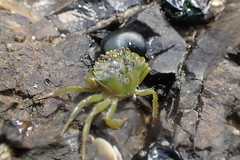
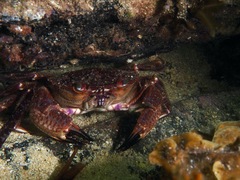
This crab has a deep reddish brown body and legs covered with short setae (hairs) described as being densely pilose giving it a velvet like appearance that gives it is common name.
The eyes are reddish brown although this feature seems to be ignored is most identification keys with other characteristics being favoured.
The frontal margin is almost straight and is tuberculated with a notch between the red eyes, there are 4 anterolateral teeth often being more like sharp spines but can be worn




Distribution and map
Distribution provided by The Atlas of Living Australia
Classification
Classification
KingdomAnimalia
PhylumArthropoda
SubphylumCrustacea
SuperclassMulticrustacea
ClassMalacostraca
SubclassEumalacostraca
SuperorderEucarida
OrderDecapoda
SuborderPleocyemata
InfraorderBrachyura
SectionEubrachyura
SuperfamilyPortunoidea
FamilyCarcinidae
GenusNectocarcinus
SpeciesNectocarcinus tuberculosus
Synonyms
Synonyms
There are no known synonyms for this species
References and dates
Original
View Original Descriptions
Bibliography
View page references
Added
Thu 1 Jan 2026 @ 05:55 AM
Updated
Thu 1 Jan 2026 @ 05:55 AM
Surveys
View Survey List
Photos
No images found for this species
Files
External Links
1 External Links
View External
Links
Disclaimer: A lot of work goes into trying to identify and ensure accurate identifications are made, and that the listed Descriptions, Sizes, Habitats and Distribution information is as accurate and valid as possible. Unfortunately, information in this arena is ever changing and as such no guarantee can be offered that it is correct or currently valid — the information is provided as a guide, and it is always suggested that you do a little research to ensure you have the latest and most accurate information. View the references or bibliography. Feedback and comments on the information provided are always welcome.
From Our Tasmania · https://ourtasmania.au/species-guide/view-species/nectocarcinus-tuberculosus/