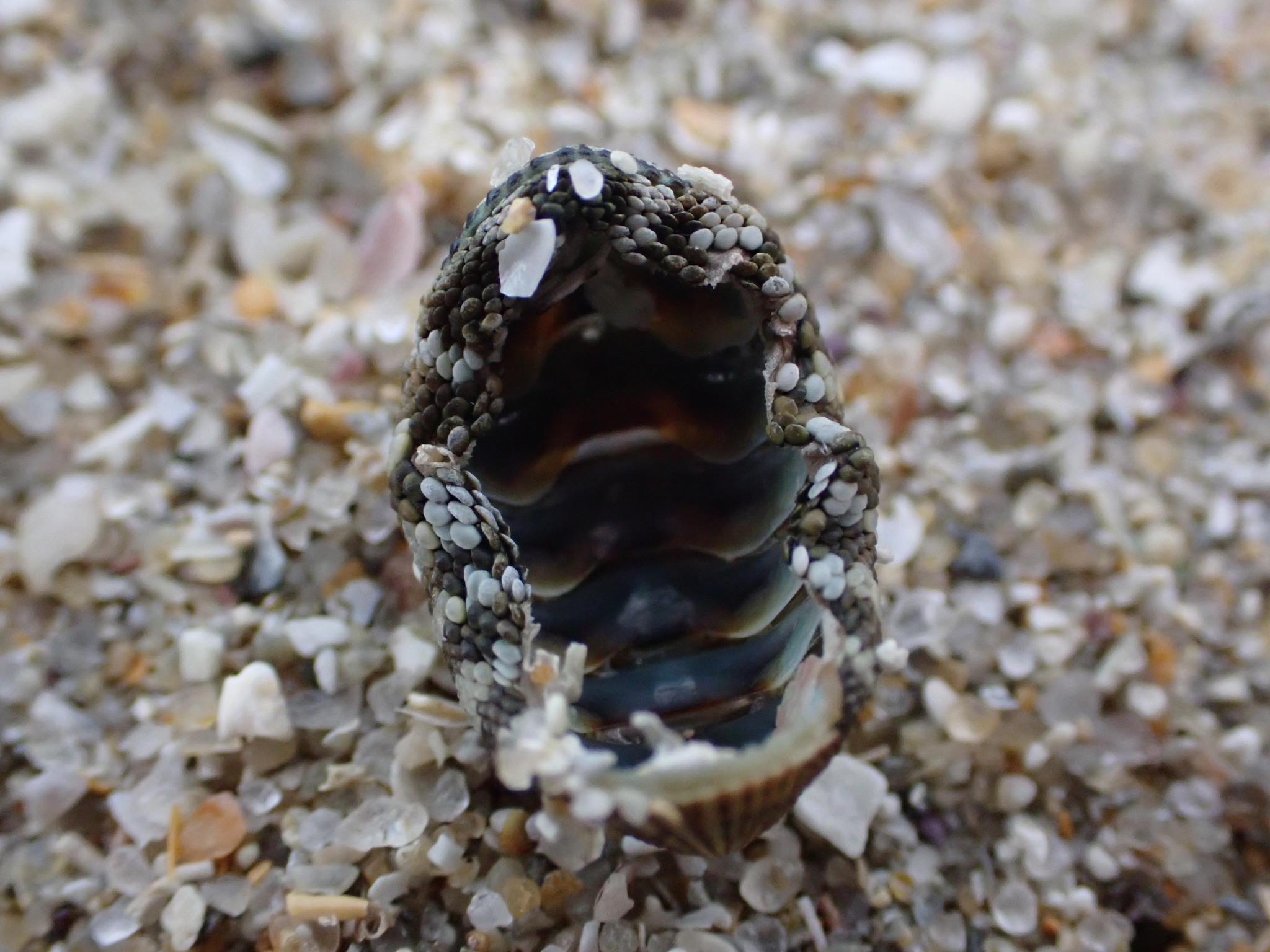
The snakeskin chiton is recongnised by the eight overlapping articulated shell plates on its back and the surface of the girdle in this chiton has a pattern of overlaying scales resembling snakeskin.
They have relatively flexible bodies and can squeeze into narrow crevices – unlike limpets, whose rigid shell prevents entry into such spaces. If detached from rocks, they roll into a ball just as a slater (woodlouse) does
At a glance
Snakeskin Chiton at a glance
Habitat
Lives intertidally attached to rocks, especially on sheltered shores They cling to rocks with a muscular grip and move slowly over surfaces at high tide. At low tide the animals mostly retreat to crevices or the undersides of rock
Size
Total length up to 6 cm
Origin
Native
Distribution
South-eastern Australia including Tasmania, Victoria and New South Wales
Descriptions
Distribution
South-eastern Australia including Tasmania, Victoria and New South Wales
Habitat
Lives intertidally attached to rocks, especially on sheltered shores
They cling to rocks with a muscular grip and move slowly over surfaces at high tide.
At low tide the animals mostly retreat to crevices or the undersides of rock
Size
Total length up to 6 cm
Distribution and map
Distribution provided by The Atlas of Living Australia
Classification
Classification
KingdomAnimalia
PhylumMollusca
ClassPolyplacophora
SubclassNeoloricata
OrderChitonida
SuborderChitonina
FamilyChitonidae
SubfamilyChitoninae
GenusSypharochiton
SpeciesSypharochiton pelliserpentis
Synonyms
Synonyms
There are no known synonyms for this species
References and dates
Original
No original text available
Bibliography
View page references
Added
Wed 27 May 2020 @ 00:00 AM
Updated
Sat 4 Dec 2021 @ 23:00 PM
Surveys
View Survey List
Photos


Files
External Links
2 External Links
View External
Links
Disclaimer: A lot of work goes into trying to identify and ensure accurate identifications are made, and that the listed Descriptions, Sizes, Habitats and Distribution information is as accurate and valid as possible. Unfortunately, information in this arena is ever changing and as such no guarantee can be offered that it is correct or currently valid — the information is provided as a guide, and it is always suggested that you do a little research to ensure you have the latest and most accurate information. View the references or bibliography. Feedback and comments on the information provided are always welcome.
From Our Tasmania · https://ourtasmania.au/species-guide/view-species/sypharochiton-pelliserpentis/