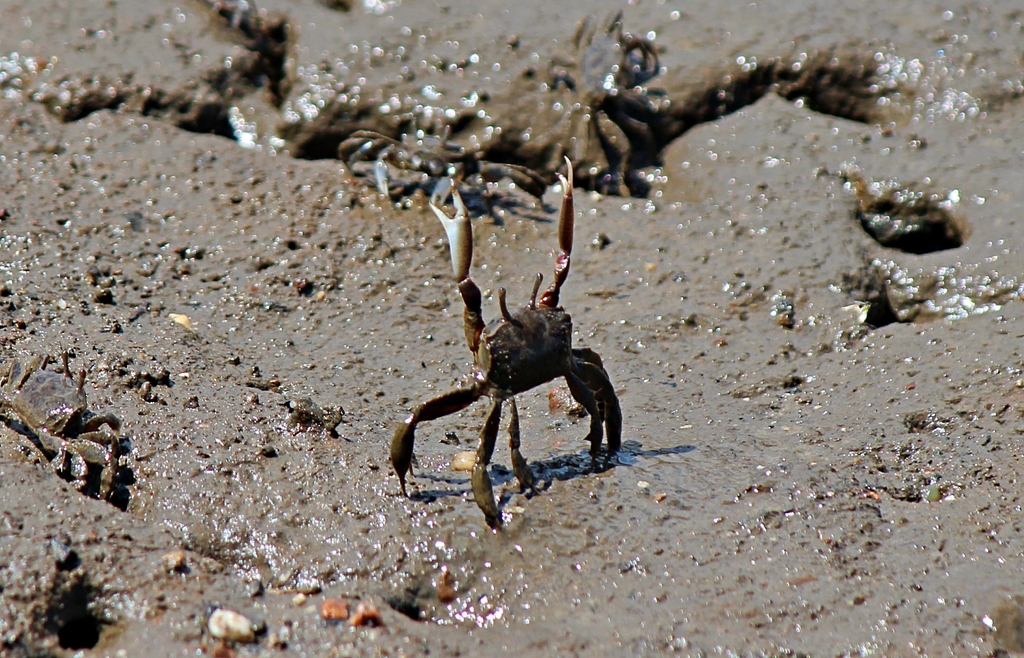
A crab that lives in burrows on mudflats and can easily be mistaken for Heloecius cordiformis that lives in the same environments. The Southern Sentinel Crab is less common however.
At a glance
Southern Sentinel Crab at a glance
Habitat
In burrows on intertidal mudflats.
Size
A carapace width of up to around 30mm
Origin
Endemic
Distribution
South-eastern Australia including around Tasmania
Descriptions
Distribution
South-eastern Australia including around Tasmania
Habitat
In burrows on intertidal mudflats.
Size
A carapace width of up to around 30mm
Identification
A yellowish brownish carapace that is wider than it is long with three teeth in the side of the carapace one at the eye and a further two behind that. The edges of the legs in particular the last two have fine hairs or setae. The fixed finger of the chelae is angled downwards. The eye stalks are long
Distribution and map
Distribution provided by The Atlas of Living Australia
Classification
Classification
KingdomAnimalia
PhylumArthropoda
SubphylumCrustacea
SuperclassMulticrustacea
ClassMalacostraca
SubclassEumalacostraca
SuperorderEucarida
OrderDecapoda
SuborderPleocyemata
InfraorderBrachyura
SectionEubrachyura
SuperfamilyOcypodoidea
FamilyMacrophthalmidae
SubfamilyMacrophthalminae
GenusTasmanoplax
SpeciesTasmanoplax latifrons
Synonyms
Synonyms
There are no known synonyms for this species
References and dates
Original
No original text available
Bibliography
View page references
Added
Tue 6 Dec 2022 @ 23:00 PM
Updated
Tue 6 Dec 2022 @ 23:00 PM
Surveys
View Survey List
Photos
No images found for this species
Files
External Links
2 External Links
View External
Links
Disclaimer: A lot of work goes into trying to identify and ensure accurate identifications are made, and that the listed Descriptions, Sizes, Habitats and Distribution information is as accurate and valid as possible. Unfortunately, information in this arena is ever changing and as such no guarantee can be offered that it is correct or currently valid — the information is provided as a guide, and it is always suggested that you do a little research to ensure you have the latest and most accurate information. View the references or bibliography. Feedback and comments on the information provided are always welcome.
From Our Tasmania · https://ourtasmania.au/species-guide/view-species/tasmanoplax-latifrons/