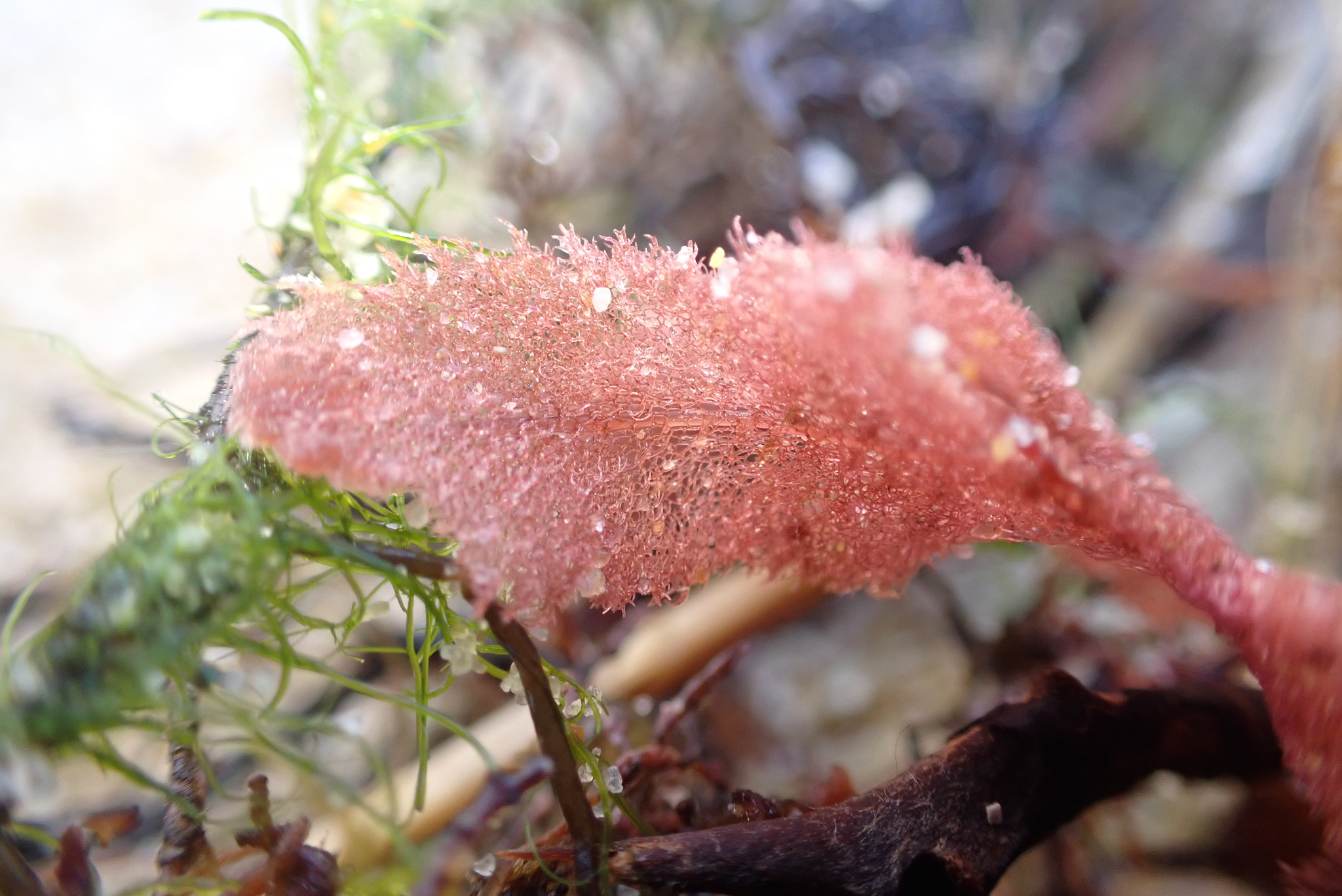
An orangey brown to dark red flat branched red algae the branches appear like a woven soft structure stemming from a central conical holdfast.
This is a common red algae washed up along the beach following rough weather
At a glance
Oak-leaved Red algae at a glance
Habitat
Usually found in deep waters along the rough southern australian coasts
Size
Can grow to around 10–25 cm high
Origin
Native
Distribution
From WA to VIC including around Tasmania
Descriptions
Distribution
From WA to VIC including around Tasmania
Habitat
Usually found in deep waters along the rough southern australian coasts
Size
Can grow to around 10–25 cm high
Identification
Thuretia quercifolia is a medium to dark red seaweed that usually grows about 10–25 cm tall.
Look for these key features:
- The plant is flat and broadly branched, giving it a leafy or feathered appearance.
- Main branches are usually around 1–2.5 cm wide.
- The branches form a distinctive fine, net-like structure when viewed closely.
- The surface can have small, fine filaments, while those along the edges may become more spine-like or bristly.
- Older parts near the base often lose the broad leafy appearance and become narrower, bare-looking stems.
- Colour ranges from medium red to dark red.
- It attaches to the substrate with a small cone-shaped holdfast and may spread along the surface by creeping runners.
Quick identification
A dark red, flat and highly branched seaweed with broad leafy sections, a fine net-like texture and slightly spiny or bristly margins.

Distribution and map
Map data unavailable. The Atlas of Living Australia (ALA) is not responding, so the distribution map cannot load right now. This is an issue with ALA's data service, not with Our Tasmania.
Distribution provided by The Atlas of Living Australia
Classification
Classification
KingdomPlantae
PhylumRhodophyta
ClassFlorideophyceae
SubclassRhodymeniophycidae
OrderCeramiales
FamilyDelesseriaceae
SubfamilyHeterosiphonioideae
GenusThuretia
SpeciesThuretia quercifolia
Synonyms
Synonyms
Dictyurus quercifolius J.Agardh 1863
References and dates
Original
No original text available
Bibliography
View page references
Added
Sun 17 Oct 2021 @ 23:00 PM
Updated
Mon 5 Oct 2026 @ 14:04 PM
Surveys
View Survey List
Photos

Files
| Type | Details | Version | Size | Added | Updated | Links |
|---|---|---|---|---|---|---|
| There are no downloads or Files for this species at the moment | ||||||
External Links
3 External Links
View External
Links
Disclaimer: A lot of work goes into trying to identify and ensure accurate identifications are made, and that the listed Descriptions, Sizes, Habitats and Distribution information is as accurate and valid as possible. Unfortunately, information in this arena is ever changing and as such no guarantee can be offered that it is correct or currently valid — the information is provided as a guide, and it is always suggested that you do a little research to ensure you have the latest and most accurate information. View the references or bibliography. Feedback and comments on the information provided are always welcome.
From Our Tasmania · https://ourtasmania.au/species-guide/view-species/thuretia-quercifolia/