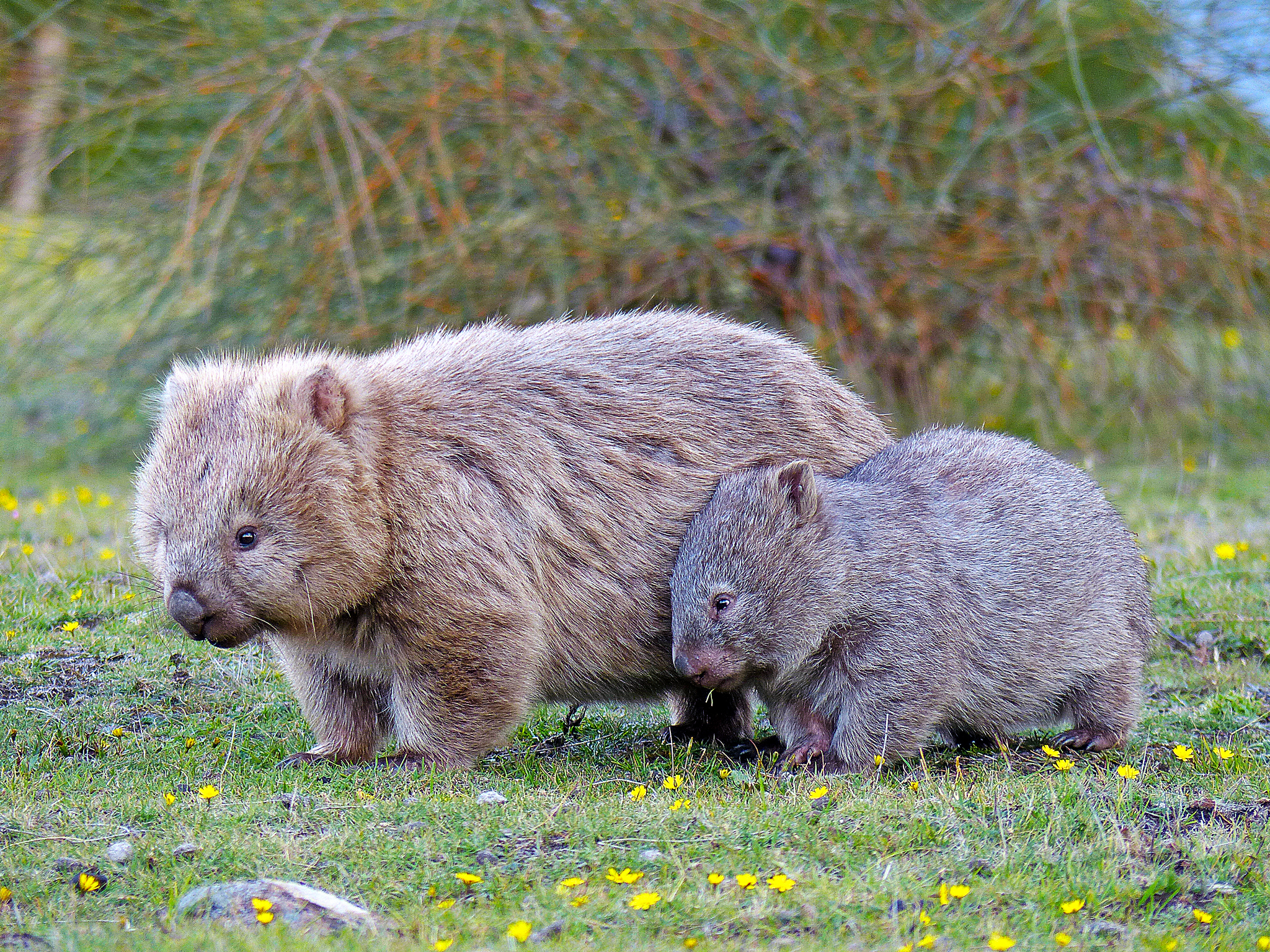
Wombats are mainly nocturnal and crepuscular, emerging fromtheir burrows at dusk to graze in the cooler night temperatures. However duringcolder seasons, they may be seen sunbathing in the day.
They are equipped with powerful limbs, short broad feet andflattened claws. They have a short stocky body with a broad head.
Theydiffer from other marsupials by having only two incisor teeth in the upper jaw.The incisor and molar teeth of this animal are also unique because they haveopen roots and continue to grow throughout the animal’s life.
At a glance
Common Wombat at a glance
Habitat
Dry and wet forest, woodland and coastal heath and pasturelands
Size
Can grow to around 110cm and can weigh in at up to around 35kg
Origin
Native
Distribution
South-eastern mainland Australia and Tasmania
Descriptions
Distribution
South-eastern mainland Australia and Tasmania
Habitat
Dry and wet forest, woodland and coastal heath and pasturelands
Size
Can grow to around 110cm and can weigh in at up to around 35kg
Distribution and map
Distribution provided by The Atlas of Living Australia
Classification
Classification
KingdomAnimalia
PhylumChordata
SubphylumVertebrata
SuperclassGnathostomata
ClassMammalia
SubclassMarsupialia
OrderDiprotodontia
SuborderVombatiformes
FamilyVombatidae
GenusVombatus
SpeciesVombatus ursinus
Synonyms
Synonyms
There are no known synonyms for this species
References and dates
Original
No original text available
Bibliography
View page references
Added
Wed 15 Jul 2020 @ 00:00 AM
Updated
Tue 16 Nov 2021 @ 23:00 PM
Surveys
View Survey List
Photos
Files
External Links
5 External Links
View External
Links
Disclaimer: A lot of work goes into trying to identify and ensure accurate identifications are made, and that the listed Descriptions, Sizes, Habitats and Distribution information is as accurate and valid as possible. Unfortunately, information in this arena is ever changing and as such no guarantee can be offered that it is correct or currently valid — the information is provided as a guide, and it is always suggested that you do a little research to ensure you have the latest and most accurate information. View the references or bibliography. Feedback and comments on the information provided are always welcome.
From Our Tasmania · https://ourtasmania.au/species-guide/view-species/vombatus-ursinus/