Introduction
Tomahawk Beach on Tasmania's north-east coast is one of the most productive intertidal sites in the state. On a good low tide the rock shelves and pools reveal a remarkable diversity of invertebrate life — and crabs in particular are abundant, varied, and frequently misidentified.
This guide focuses on the three species you are most likely to encounter during a low-tide visit. Two are native, one is an introduced pest that has established itself across Australian coastlines. Knowing which is which matters — not just for your field notes, but for reporting invasive species to the relevant authorities.
"Tomahawk's rock shelves reward patience. Sit still for five minutes at any pool edge and the crabs will emerge from beneath their ledges."
— BushRenegade, Field Notes 2024European Green Crab (Carcinus maenas)
The European Green Crab is the species you most need to be able to identify with confidence. It is an introduced invasive and one of the world's most damaging marine pests. In Tasmania it has established populations at numerous coastal locations and continues to spread.
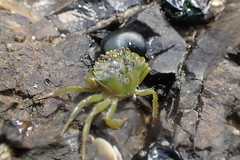
If you find one: do not release it back into the water. Report sightings to the Invasive Species Council or via iNaturalist and tag it as Carcinus maenas.
The single most reliable field character is the count of anterolateral teeth — the spiny projections along the front edge of the carapace beside the eyes. Green crabs have exactly five on each side. This feature alone separates it from every native Tasmanian crab species.
Notched Shore Crab (Paragrapsus quadridentatus)
The Notched Shore Crab is Tasmania's most commonly encountered intertidal crab. It lives in large numbers under rocks, in crevices, and in the splash zone — often found in clusters of a dozen or more individuals sheltering together beneath a single flat rock.
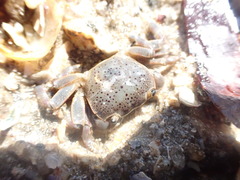
Field tip: Replace rocks carefully after checking underneath. These crabs depend on the microhabitat beneath them and overturned rocks that dry out in the sun can kill entire communities.
Rough Rock Crab (Nectocarcinus integrifrons)
The Rough Rock Crab is a native swimming crab found in the lower intertidal and shallow subtidal zones. It is a fast, alert crab that will quickly retreat to deeper water when disturbed — so the best sightings come from waiting quietly at pool edges.
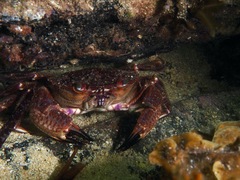
Field ID Tips
When you only have a few seconds before a crab disappears under a ledge, these quick characters will help you make a reliable call:
| Character | Green Crab | Shore Crab | Rock Crab |
|---|---|---|---|
| Lateral teeth | 5 each side | 4 front margin | 9 each side |
| Carapace shape | Fan-shaped | Square | Wide, granular |
| Size | Up to 90 mm | Up to 35 mm | Up to 80 mm |
| Rear legs | Pointed | Pointed | Paddle-shaped |
| Underside | Yellow-orange | Cream-white | Pale cream |
| Status | Invasive ⚠️ | Native ✓ | Native ✓ |
Photographing for iNaturalist: Aim to capture the dorsal (top), ventral (underside), and a lateral (side) view. The underside colouration and the front-margin teeth count are usually the most important characters for identification.
Conservation Note
Tasmania's intertidal ecosystems are under increasing pressure from introduced species, coastal development, and climate-driven changes to water temperature and ocean chemistry. The European Green Crab is particularly concerning — it is an aggressive predator and competitor that can devastate native shellfish populations and alter habitat structure.
If you are visiting Tomahawk or any other Tasmanian intertidal site, you can contribute meaningfully to monitoring efforts by logging your observations on iNaturalist Australia. Photo records of European Green Crabs are especially valuable for tracking their spread.
From Our Tasmania · https://ourtasmania.au/blogs-news/article/identifying-crabs-at-tomahawk-beach/




Share observations, corrections, field notes, or general feedback.
Leave a Comment