Identifying two nearly identical crabs like the Smooth Shore Crab (Cyclograpsus audouinii) and the Purple-Mottled Shore Crab (Cyclograpsus granulosus) is notoriously difficult. They share the same size, overlapping habitats and highly variable colouring.
Both are small native intertidal scavengers growing to roughly 4 cm across. They have heavily rounded carapaces that lack the side teeth or spines found on most other shore crabs, which makes confirming one in the field a real test of patience.
The short answer
Colour will not separate them. Turn the crab over — the hair between the bases of the walking legs is the most reliable difference.
Meet the Two Crabs
On paper the two look like the same animal. The differences are in the detail, so it helps to know what each one is supposed to have before you start looking.
The Dorsal View: From Above
From above, the two present exactly the same silhouette. The genus Cyclograpsus has a compact, nearly circular carapace with no anterolateral teeth — the notches most shore crabs have along the sides of the shell — so outline alone tells you nothing.

What the top of the shell can give you is texture. Look at the front of the carapace, just behind the eyes. On C. granulosus the surface is slightly granulated there; on C. audouinii it stays smooth. The difference is subtle, so it needs a sharp, well-lit photo rather than a glance.
The Ventral View: The Underside
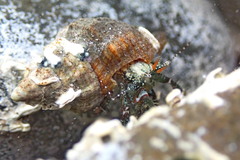
The underside is where the answer usually is. Where the walking legs join the body, C. audouinii carries tufts of long hair between the leg bases. C. granulosus has only short, sparse hairs in the same place.
Up close, the difference between the leg bases is clear:
Photographing the underside: get a clear shot of where the walking legs attach to the body. Hold the crab gently from behind, keep it wet, and put it back where you found it under the same rock.
Key Features Side by Side
Together, these are the features that separate established specimens:
| Feature | C. audouinii | C. granulosus |
|---|---|---|
| Leg-base hair | Tufts of long hair between the bases of the walking legs | Only short, sparse hairs at the leg bases |
| Carapace texture | Entirely smooth | Slightly granulated, especially near the front |
| Male claws | Massive, sometimes unequal, with a swollen crest on the inner palm | Sturdy, without a prominent crest on the inner palm |
| Habitat | Sheltered rocky areas, often into estuaries | Under rocks on open, moderately exposed coasts |
The claws are only useful on males, which is why they come third. When you do have a male, look at the inner face of the palm:
Why Are They So Hard to Tell Apart?
1. Unreliable colour
Both species vary enormously in colour, between individuals and between sites. Both are mottled in shades of red, brown, purple and yellow, so relying on colour will almost always lead to a misidentification.
Relying on colour alone to identify a Cyclograpsus in a rock pool will almost always lead you astray. Look closer, at the structure.
2. Identical outlines
With no side teeth on either shell, the two present the same rounded, smooth-edged silhouette. Nothing about the shape seen from above separates them.
3. Hybrids
To add to the confusion, the two species are known to occasionally hybridise where their populations overlap along the south-east Australian coast. The result is intermediate individuals with a confusing mix of smooth and granulated traits.
Because of hybrids, not every crab can be named to species. If the features disagree, recording it as Cyclograpsus is the honest answer.
Contributing to Intertidal Science
If you find one of these on your next low tide, take clear photos of the top of the carapace, a side angle and the underside. Those three views are what let someone else confirm the identification.
Uploading your records to iNaturalist Australia helps map local variation and where the two species overlap and hybridise along our coast.
From Our Tasmania · https://ourtasmania.au/blogs-news/article/the-two-cyclograpsus-crabs-of-southern-australia/



Share observations, corrections, field notes, or general feedback.
Leave a Comment