As Written by (Filhol, 1885)
J'ai trouvé cette espèce dans le détroit de Cook et sur la côte est de l'île Stewart. Le front s'avance beaucoup en avant et se termine sur la ligne médiane par un prolongementanguleux assez accusé. L'anneau ophthalmique est presque complè- tement caché sous le bord antérieur de la carapace. Les antennes externes sont longues, dégarnies de poils et alternativement colorées en blanc et en rouge. Le nombre des articles possédant cette dernière couleur est de beaucoup supé- rieur à celui des autres.
L'épine correspondant au palpe est développée et revêtue de poils sur tout son bord interne. En dehors et en haut de l'article supportant les antennes, il existe une petite épine poilue à son sommet. Le bras droit est très fort. Le carpe, la main et les doigts sont revêtus de poils longs et nombreux.
Au-dessous d'eux, on aperçoit, tant sur la face externe du carpe que sur celle de la main et des doigts, des tubercules nombreux, de forme conique, aigus à leurssommets.
Ces saillies constituent sur la main six séries linéaires à direction antéro-postérieure. Les bords supérieur et inférieur de la main sont également tuberculeux sur toute leur étendue. Le bord supérieur du carpe du bras gauche offre une double rangée d'épines alternant avec des paquets de poils.
La petite main est granuleuse et garnie, comme celle du côté opposé, de poils longs et nombreux. Les pattes ambulatoires des deux premières paires sont allongées et très velues tant dans leur bord supérieur que dans leur bord infé- rieur.
L'abdomen est dépourvu de plaques. Cette espèce se distingue de EupagurusEdwardsi par sa taille beaucoup plus réduite, par la forme des granulations épineuses et non en bouton couvrant les mains; par la, saillie anguleuse de l'extrémité antérieure du front, par la position de l'anneau ophtalmique presque caché et non apparent.
Ce dernier caractère sert également à la faire reconnaître de Eupagurus Novae Zelandiæ, chez lequel, d'autre part, la main est nue, alors que les tubercules qui la couvrent sont mousses et disposés différemment. Les dimensions de Eupagurus Traversi sont: Longueur. 0m,025 Largeur de la carapace. 0 ,005
Latin to English
I found this species in the Cook Strait and on the east coast of Stewart Island. The frons projects considerably forward and terminates at the midline in a rather pronounced angular extension. The eye ring is almost completely hidden beneath the anterior margin of the carapace.
The external antennae are long, hairless, and alternately colored white and red. The number of segments with the latter color is much greater than that of the others. The spine corresponding to the palp is well-developed and covered with hairs along its entire inner edge. Outside and at the top of the segment supporting the antennae, there is a small hairy spine at its tip.
The right arm is very strong. The carpus, hand, and fingers are covered with numerous long hairs. Below these, on both the outer surface of the carpus and that of the hand and fingers, numerous conical tubercles, pointed at their apexes, are visible. These projections form six linear series on the hand, running from anteroposteriorly. The upper and lower edges of the hand are also tuberculate along their entire length.
The upper edge of the carpus of the left arm has a double row of spines alternating with tufts of hair. The small hand is granular and, like the one on the opposite side, covered with numerous long hairs.
The walking legs of the first two pairs are elongated and very hairy on both their upper and lower edges. The abdomen lacks plates. This species is distinguished from *Eupagurus Edwardsi* by its much smaller size; by the shape of the spiny, rather than button-like, granulations covering the hands; by the angular projection at the anterior end of the frons; and by the position of the eye ring, which is almost hidden and not visible.
This last characteristic also helps to distinguish it from Eupagurus novae zelandiæ, in which, moreover, the hand is bare, while the tubercles covering it are blunt and arranged differently.
The dimensions of Eupagurus traversi are:
Length: 0.025 m
Carapace width: 0.005 m
What Does It Mean?
Other Key Points:
A pointed front edge of the shell between the eyes.
Eyes that sit partly hidden beneath the front edge of the shell.
Long red-and-white antennae.
A large, strong right claw covered in long hairs.
Numerous small, pointed bumps in 6 rows on the larger claw.
A smaller left claw that is also hairy, with the same type of bumps as the larger claw just in two rows.
The first two pairs of walking legs are long and noticeably hairy.
The partly hidden eyes, pointed front of the shell and sharp bumps on the claws are particularly useful identification features.
The original specimen was about 25 mm long, with a shell around 5 mm wide.
(Note: It is reasonable to believe it is named after the naturalist and collector William Travers, who provided many early New Zealand specimens to European taxonomists in the late 19th century. This would give us a vernacular name: Travers’ hermit crab (or Traversi's hermit crab) although I have found no specific references to this but Filhol and others used this exact naming pattern throughout the same monograph to honour local scientists)
Identification
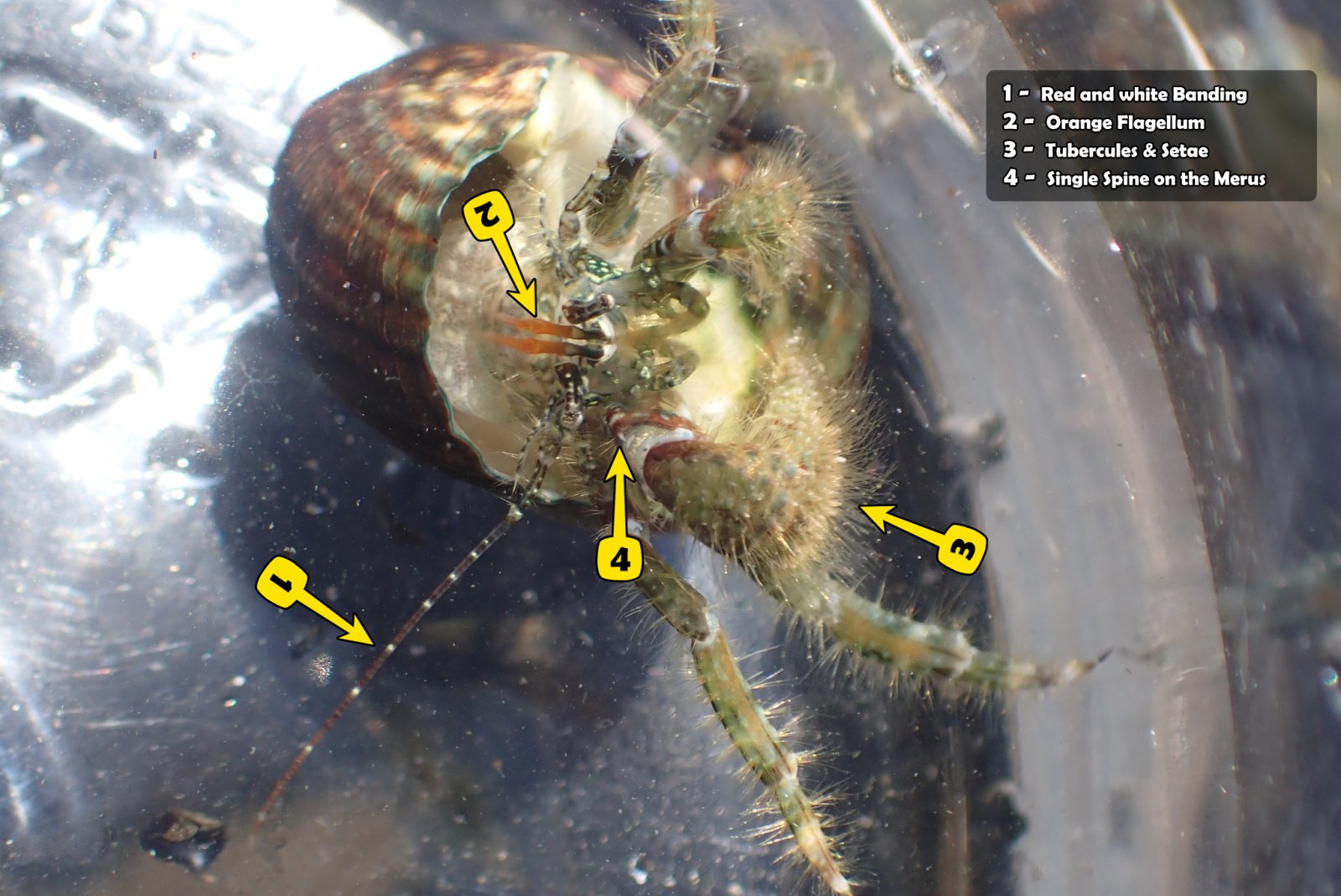
Commonly greenish brown in colour across the body and chelae, with deep red and white banding on the antenna, flagellum bright orange.
6 rows of sharp tubercules and setae on the outer surface of the chelae and a spine on the distal upper of the meri of the chelae
Disclaimer: A lot of work goes into trying to identify and ensure accurate identifications are made and that the listed Descriptions, Sizes, Habitats and Distribution information is as accurate and valid as possible. Unfortunately, information in this arena is ever changing and as such no guarantee can be offered that it is correct or currently valid — as a result the information is provided as a guide, and it is always suggested that you do a little research to ensure you have the latest and most accurate information.


