Pagurus traversi: From a Tasmanian Observation to a World First
Before getting into how to identify Pagurus traversi, I think it is worth telling the story of how this little hermit crab came to be formally recognised in Australia.
It is a story that began with observations made by ordinary people along the coast, grew through discussions within the citizen science community, and eventually brought together naturalists, researchers and museum specialists.
The result was something quite remarkable.
Pagurus traversi is now recognised not only as a species occurring in Australia, but as the first recorded translocated hermit crab species in the world.
Eichler et al. (2024), Memoirs of Museum Victoria 83 · See the referenceIt is worth stopping for a moment and thinking about that.
Here we are in the 2020s, at a time when we might assume the movements and distributions of coastal species are already reasonably well understood, yet a world first involving the translocation of a hermit crab species was uncovered — and Tasmania played an important part in that story.
Citizen Science Working Together
This identification was not the work of one person or one organisation.
It came about through the combined efforts of a number of people and communities, including observations made here in Tasmania, the wider iNaturalist community, the Marine Research Group of the Field Naturalists Club of Victoria, and the staff and scientific resources of Museums Victoria.
One person I would particularly like to acknowledge is Eiji Myorin, whose knowledge, observations and comments within the worldwide iNaturalist community are enormously valuable.
Platforms such as iNaturalist demonstrate just how important citizen science has become. A photograph uploaded by someone walking along a beach in Tasmania can be seen by knowledgeable people on the other side of the world, discussed, questioned and compared with other records.
Sometimes those conversations lead somewhere completely unexpected.
The contribution of the Marine Research Group of the Field Naturalists Club of Victoria — commonly known as the MRG — was particularly important in progressing this identification.
Personally, I want to acknowledge John, Audrey and the other MRG volunteers whose efforts helped make the identification of this species possible.
Groups such as the MRG carry out an enormous amount of valuable work documenting and understanding our marine environment, while also supporting members of the wider community who are trying to identify what they have found.
If you live in Victoria, I would encourage you to have a look at the work they are doing and consider supporting them.
And wherever you happen to live, why not find your own local Field Naturalists Club or similar natural history group? You may be surprised at just how much is happening in your local area — and how easy it can be to become involved.
The scientific work and resources of Museums Victoria ultimately provided the professional taxonomic expertise needed to bring all of these observations together.
Without that combination of community observations and professional scientific expertise, we may still have been guessing at the identity of these crabs today.
Where My Part of the Story Began
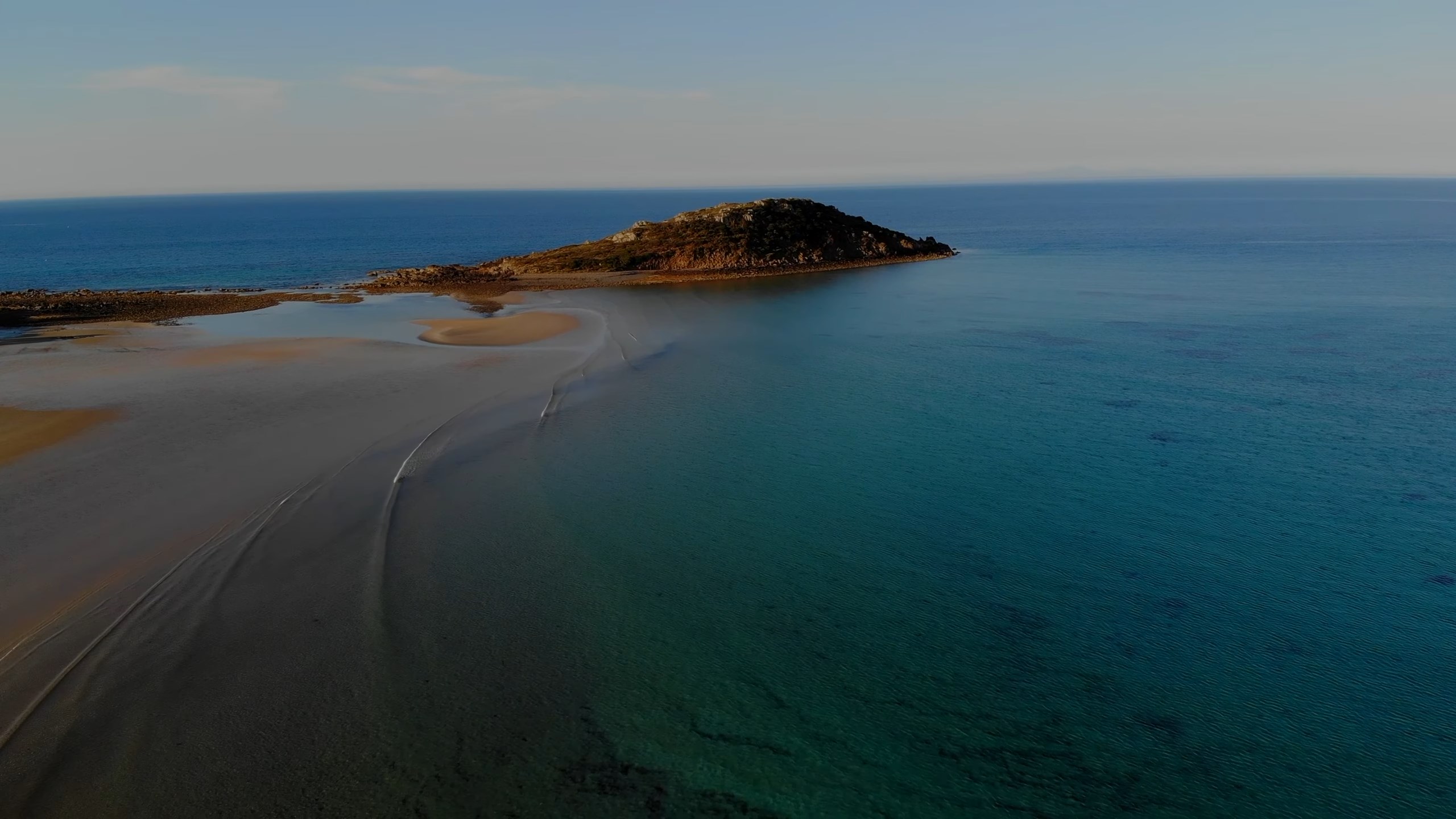
For me, the story began in September 2020 on the northern side of Tomahawk Island in Tasmania.
While exploring the intertidal zone at low tide, I noticed a number of small hermit crabs living beneath rocks.
They were small, easily overlooked animals, but there was something about them that caught my attention.
I managed to photograph one of the crabs and later that day uploaded the observation to iNaturalist Australia.
Like many observations uploaded to citizen science platforms, the identification did not begin with the correct species.
I initially recorded the crab as another species before later reconsidering the identification and moving it back to a broader family-level classification.
And that is an important part of citizen science. You do not have to know exactly what something is before recording it. Sometimes the most useful thing you can do is simply take clear photographs, record where and when you found it, upload the observation and allow the wider community to help.
More Observations Begin to Appear
Over time, more of these hermit crabs were observed.
Some of those observations were mine, while others were recorded by different observers, including Nick Shaw.
One of Nick's iNaturalist observations became particularly useful because the public discussion attached to that record shows part of the identification process unfolding.
Those comments demonstrate something that is often hidden when we simply look at a final species name in a field guide.
Identification can be a process.
- People compare photographs.
- They question earlier assumptions.
- They look at geographic distributions.
- They examine anatomical features.
- They compare specimens with museum material and published descriptions.
And sometimes an observation that originally looked fairly ordinary becomes scientifically significant.
That is essentially what happened here.
From Observation to Formal Recognition
As more information accumulated, these Australian hermit crabs attracted greater attention.
The combination of citizen science records, discussion among naturalists and the involvement of experienced marine researchers eventually led to the material being investigated in much greater detail.
That work culminated in the formal recognition of the New Zealand species Pagurus traversi in Australia.
More importantly, the research identified it as a translocated species — a species that has somehow moved beyond its known native range and established itself elsewhere.
The Australian population is now known from southern New South Wales through to Tasmania.
Exactly how Pagurus traversi arrived in Australia remains uncertain.
Shipping, marine infrastructure and other forms of human-assisted transport are obvious possibilities when discussing marine species movements, but without evidence it would be wrong to claim a particular pathway.
What we do know is much simpler.
It is here.
And based on its established distribution, it appears that Pagurus traversi is now part of Australia's coastal marine environment.
A Small Crab With a Much Bigger Story
There is something I find particularly interesting about this whole process.
When I turned over those rocks at Tomahawk Island in September 2020, I was simply documenting another animal living in Tasmania's intertidal environment.
There was no reason at the time to think that this small hermit crab would eventually become part of a much larger scientific story.
Yet that single observation became one small piece in a chain of records, discussions and research that ultimately contributed to understanding the presence of Pagurus traversi in Australia.
That is why citizen science matters.
You never really know which observation might become important.
The animal under the next rock, hidden in the next rock pool or photographed on your next snorkel might already be well known.
Or it might raise a question that nobody has properly answered yet.
The important thing is to observe, photograph, record and share.
Professional science and citizen science do not need to exist separately. This story demonstrates what can happen when both communities work together.
From a tiny hermit crab beneath a Tasmanian rock came an Australian species record, an international collaboration and, ultimately, the first documented example of a translocated hermit crab species anywhere in the world.
That is a pretty remarkable journey for such a small animal.
So, What Is Pagurus traversi?
Now that we know the story behind its identification, we can finally look more closely at the crab itself.
- We know what it is.
- We know that its Australian distribution extends from southern New South Wales to Tasmania.
- We know that it has become established outside its original New Zealand range.
What we still do not know with certainty is exactly how it arrived here.
But it is here, and it appears to be here to stay.
So the next step is getting to know it.
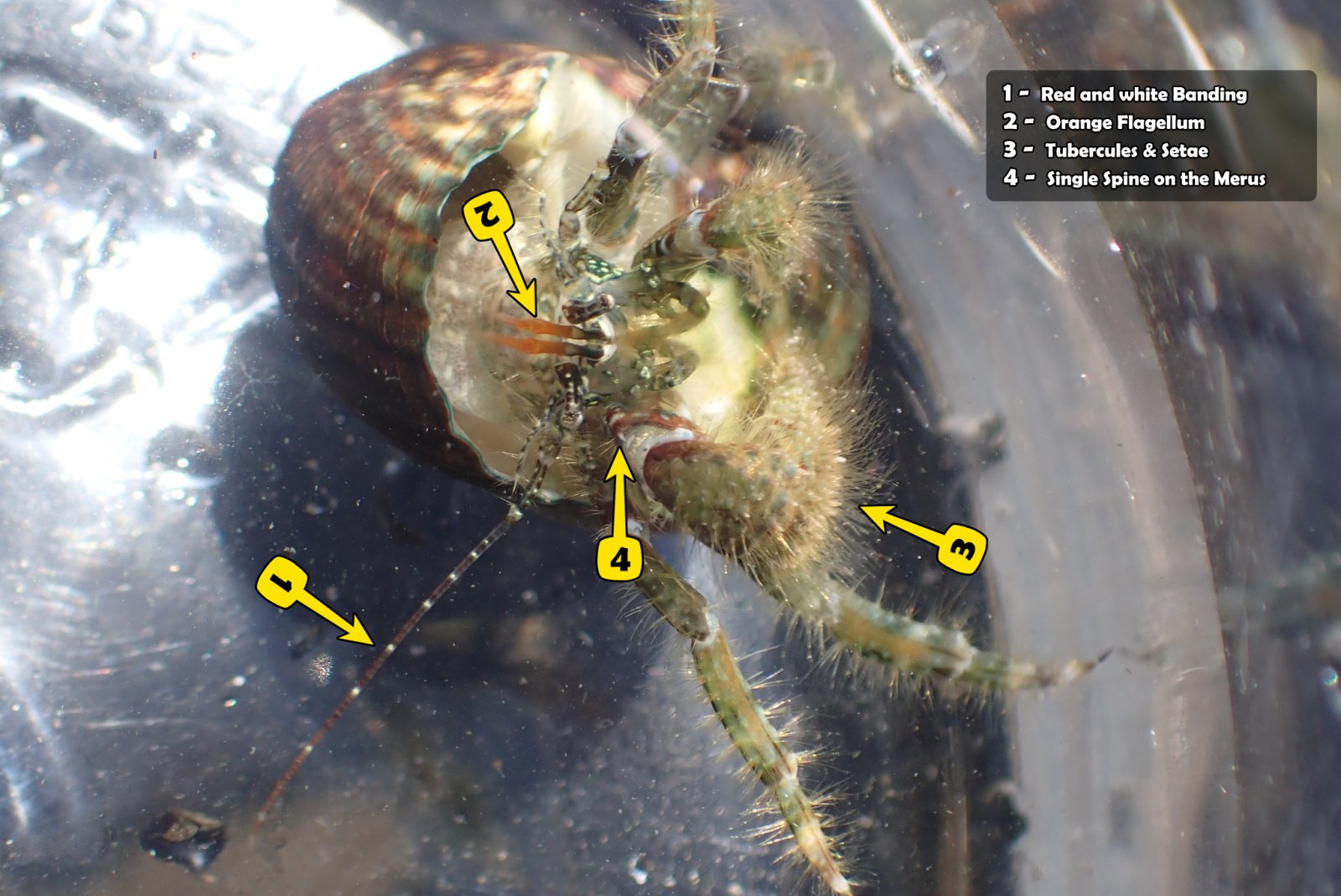
Let's take a closer look at Pagurus traversi, the features that help distinguish it from other Australian hermit crabs, and what to look for if you think you have found one yourself.
red and white banded antenna
Conservation Note
Tasmania's intertidal ecosystems are under increasing pressure from introduced species, coastal development, and climate-driven changes to water temperature and ocean chemistry.
If you are visiting a Tasmanian intertidal site, you can contribute meaningfully to monitoring efforts by logging your observations on iNaturalist Australia.
Photo records of Pagurus traversi are especially valuable for tracking its spread, and they help with other questions too, such as its impact on local native species. A single image may not seem like much, but add 100 images together on a map and we have a clear view of its range.
Over time, that picture can be extended to show trends, and future programs can use the same data to help with things like native species management and to give access to key findings.
Please take the time and join us on iNaturalist Australia.
Reference
Eichler, J., Hall, B., Farrelly, C., Falconer, A., and Poore, G.C.B. 2024. The New Zealand Pagurus traversi (Filhol, 1885) (Crustacea: Decapoda: Anomura: Paguridae) in Australia, first record of a translocated hermit crab. Memoirs of Museum Victoria 83: 317–323. https://doi.org/10.24199/j.mmv.2024.83.04
The paper acknowledges the observations from Tomahawk posted to iNaturalist, alongside those of Nick Shaw.
From Our Tasmania · https://ourtasmania.au/blogs-news/article/pagurus-traversi-found-in-tasmania/




Share observations, corrections, field notes, or general feedback.
Leave a Comment